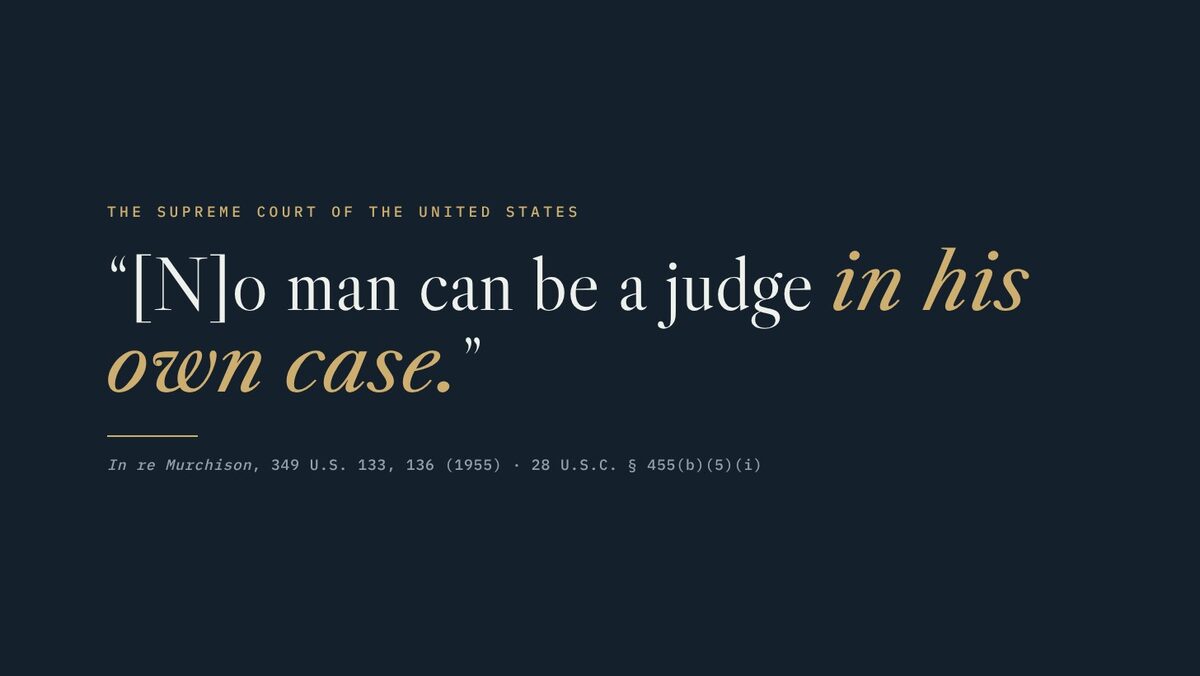
“[N]o man can be a judge in his own case.” — In re Murchison, 349 U.S. 133, 136 (1955)
THE SHORT VERSION
- A federal judge accepted, “as true,” that a fraud on the court took a crime victim’s rights, his status, and his restitution.
- Then he held it did not matter, because the court that entered the judgment had no jurisdiction to begin with.
- The hearing set for November 6 was cancelled. That same day, the victim filed a new petition naming the judge, and notices requiring him to step aside.
- The rules he used are available to every crime victim in America. They are listed below.
Who the victim is
Gustavo Escamilla runs Greenway Nutrients, Inc. In 2015, the Department of Homeland Security identified Greenway as a lead victim in a federal criminal counterfeiting investigation. The government’s own filings, recited in a 2018 court order, state that more than $26 million was recovered in that investigation, that Greenway “may be able to recover from an established victims’ fund,” and that the U.S. Attorney’s Office in Missouri “agreed that Greenway would be added as a victim in the government’s case.” (No. 2:17-cv-07748, Dkt. 13 at 2–3, Page ID #:210–211.)
Greenway has never received restitution. This is the story of why.
Accepted as true
On November 4, 2026, a United States District Judge in Los Angeles, the Honorable André Birotte Jr., accepted as true the victim’s allegations of fraud on the court, meaning that the court itself was deceived with false material. He said so on the record:
“Even accepting Plaintiff’s late-presented allegations of fraud on the court as true, he does not explain how such allegations overcome this Court’s lack of subject matter jurisdiction over his claims…” — No. 2:17-cv-07748, Dkt. 58 at 3, Page ID #:1468
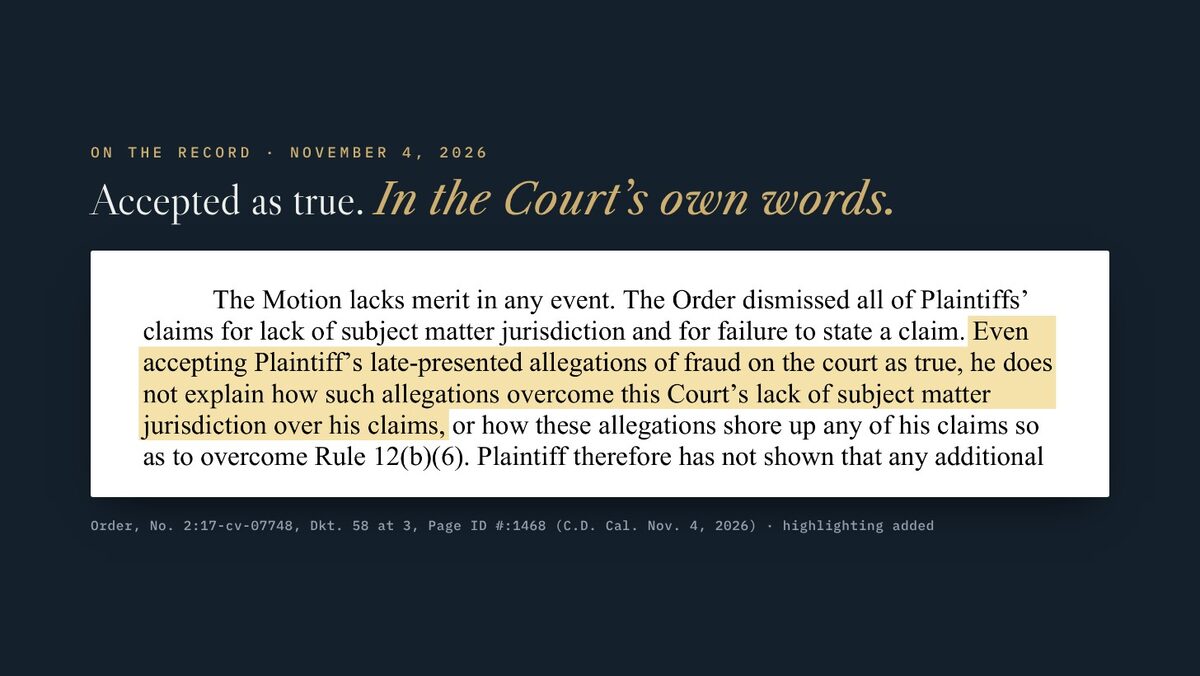
Consider what he accepted.
The victim’s motion, and the record behind it, show that a DHS special agent invoked a Colorado federal court ruling that never existed. The court had ruled the other way. (No. 2:17-cv-07748, Dkt. 1, Ex. 9, Page ID #:50; Greenway Nutrients, Inc. v. Blackburn, No. 1:13-cv-01088 (D. Colo.), Dkt. 129 at 10–11.)
The same agent used that nonexistent ruling to suspend DHS’s criminal investigation as to the victims. The U.S. Attorney’s Office for the Central District of California never corrected it. It carried the ruling into federal court in 2018, and in 2021 it recast and republished it. (No. 2:17-cv-07748, Dkt. 9 at 11, Page ID #:132; Dkt. 15 at 2–3, Page ID #:320–321.) The 2018 judgment against the victims rests on it.
And the motion showed what that fraud took: every right the Crime Victims’ Rights Act guarantees, the victims’ status as victims, and the restitution Congress made mandatory under the Mandatory Victims Restitution Act, 18 U.S.C. §§ 3663A, 3664. (No. 2:17-cv-07748, Dkt. 28.)
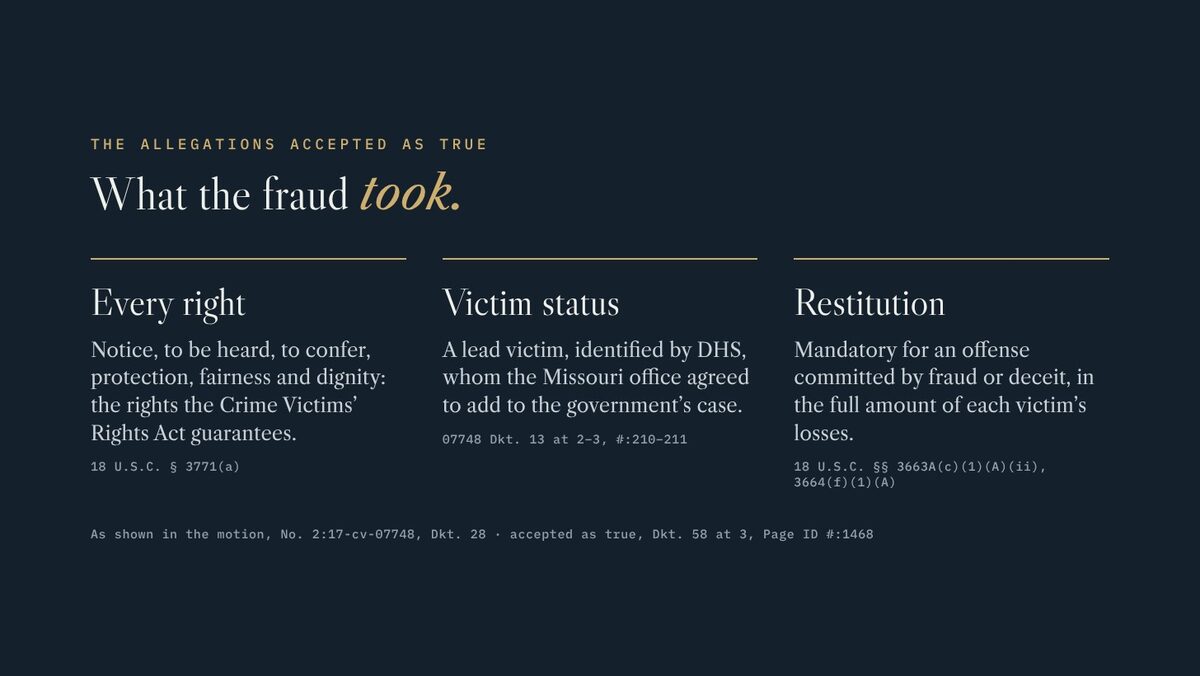
What the fraud took. As shown in the motion, No. 2:17-cv-07748, Dkt. 28 · accepted as true, Dkt. 58 at 3, Page ID #:1468.
- Every right. Notice, to be heard, to confer, protection, fairness and dignity: the rights the Crime Victims’ Rights Act guarantees. 18 U.S.C. § 3771(a).
- Victim status. A lead victim, identified by DHS, whom the U.S. Attorney’s Office in Missouri agreed to add to the government’s case. No. 2:17-cv-07748, Dkt. 13 at 2–3, Page ID #:210–211.
- Restitution. Mandatory for an offense committed by fraud or deceit, in the full amount of each victim’s losses. 18 U.S.C. §§ 3663A(c)(1)(A)(ii), 3664(f)(1)(A).
Those are the allegations Judge Birotte accepted as true. Then, in the same sentence, he held that they did not matter.
That is the concession. Everything else in this story follows from it.
Follow it to the end
If the fraud is true, the 2018 judgment was procured by fraud on the court.
If the judgment was procured by fraud, it is exactly the kind of judgment Federal Rule of Civil Procedure 60(d)(3) exists to set aside. The Supreme Court has said that power cannot “always wait upon the diligence of litigants.” Hazel-Atlas Glass Co. v. Hartford-Empire Co., 322 U.S. 238, 246 (1944).
But the order held that the fraud could not “overcome this Court’s lack of subject matter jurisdiction,” meaning the court’s lack of legal power to hear the case at all. So the judgment stands, in the order’s own words, on a court’s lack of power.
Follow that one step further. A court without jurisdiction may only “announc[e] the fact and dismiss[] the cause.” Steel Co. v. Citizens for a Better Env’t, 523 U.S. 83, 94 (1998). Its dismissal is not a judgment on the merits. Costello v. United States, 365 U.S. 265, 285 (1961).
In the Ninth Circuit, that dismissal must be without prejudice, because the court has no power to reach the merits. Kelly v. Fleetwood Enters., Inc., 377 F.3d 1034, 1036 (9th Cir. 2004). Yet the order recites that the 2018 judgment dismissed every claim “with prejudice pursuant to Fed. R. Civ. P. 12(b)(1) for lack of subject matter jurisdiction” (Dkt. 58 at 2, Page ID #:1467), and treats that label as a permanent bar the victim could not “overcome.”
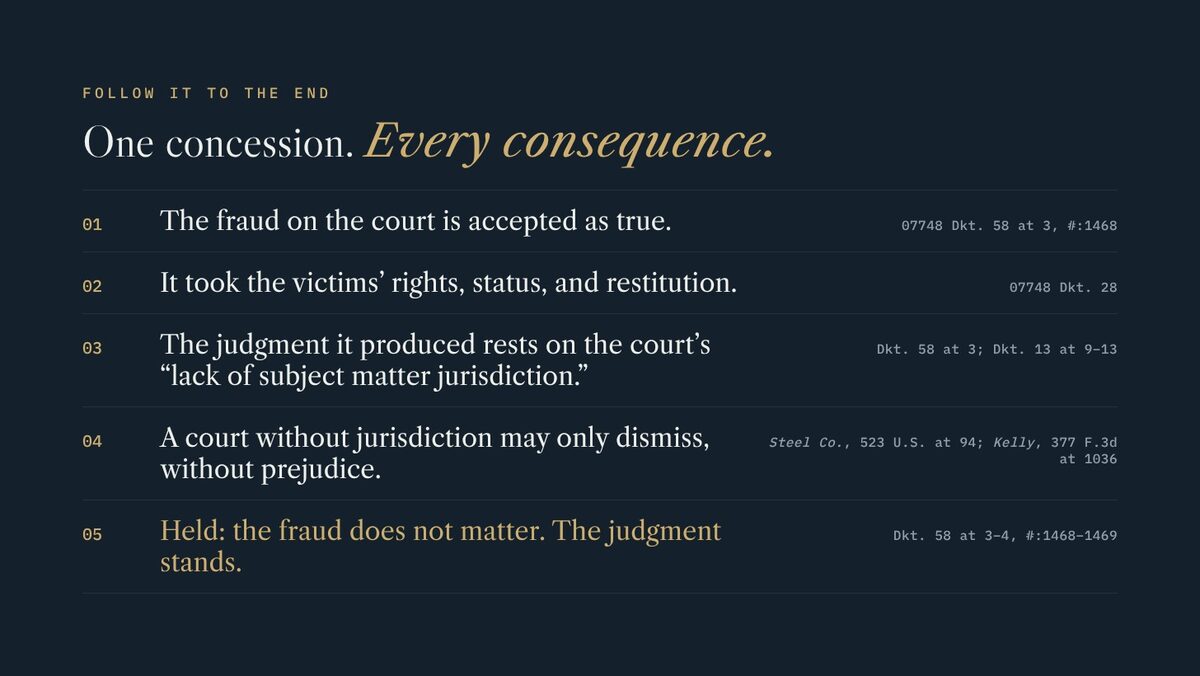
Here is the result, stated plainly and entirely from the record:
A fraud on the court, accepted as true, took a federally identified crime victim’s rights, his status, and his restitution. It was held not to matter, because the court that entered the judgment had no jurisdiction to enter it.
The fraud, accepted as true, still stands. The court had no power, and its judgment still stands.
Not matter to whom?
The order never mentions the Crime Victims’ Rights Act. It never mentions the Mandatory Victims Restitution Act. It never uses the word “restitution.”
Yet “the outcome of the case” is restitution. For an offense “committed by fraud or deceit,” the court “shall order” restitution “in the full amount of each victim’s losses.” 18 U.S.C. §§ 3663A(a)(1), (c)(1)(A)(ii), 3664(f)(1)(A). And “[n]o victim shall be required to participate in any phase of a restitution order.” § 3664(g)(1).
The order itself calls the victim and Greenway “victims of the criminal counterfeiting,” an operation that sold “millions of dollars of counterfeit versions of Plaintiff’s and Greenway’s products.” In the same sentence, it describes the victim as “dissatisfied with how the Defendants’ agents handled the case.” (Dkt. 58 at 2, Page ID #:1467.)
Victims whose rights were taken by a fraud the court accepted as true are not “dissatisfied.” They are owed what Congress made mandatory.
Whose position is that?
“It would not matter” is not a new idea. It is the U.S. Attorney’s Office’s position from 2021.
Confronted under oath with the same record, the Office did not deny the fraud. It argued that, “assuming arguendo” (Latin for “for the sake of argument”) a fraud on the court existed, “it would not ‘affect the outcome of the case.’” (No. 2:17-cv-07748, Dkt. 23 at 5, Page ID #:753.) Those allegations of professional misconduct, multiple, specific, and sworn, have never been denied on the merits.
In 2026 the Office did not have to say it again. Its deadline to oppose the victim’s motion was October 16. It filed nothing. The order explains why that was no obstacle: “Upon review of these filings and the entire docket, neither oppositions nor a hearing are necessary.” (Dkt. 58 at 1, Page ID #:1466.)
The Office assumed the fraud in 2021. The Court accepted it as true in 2026. Neither has ever denied it.
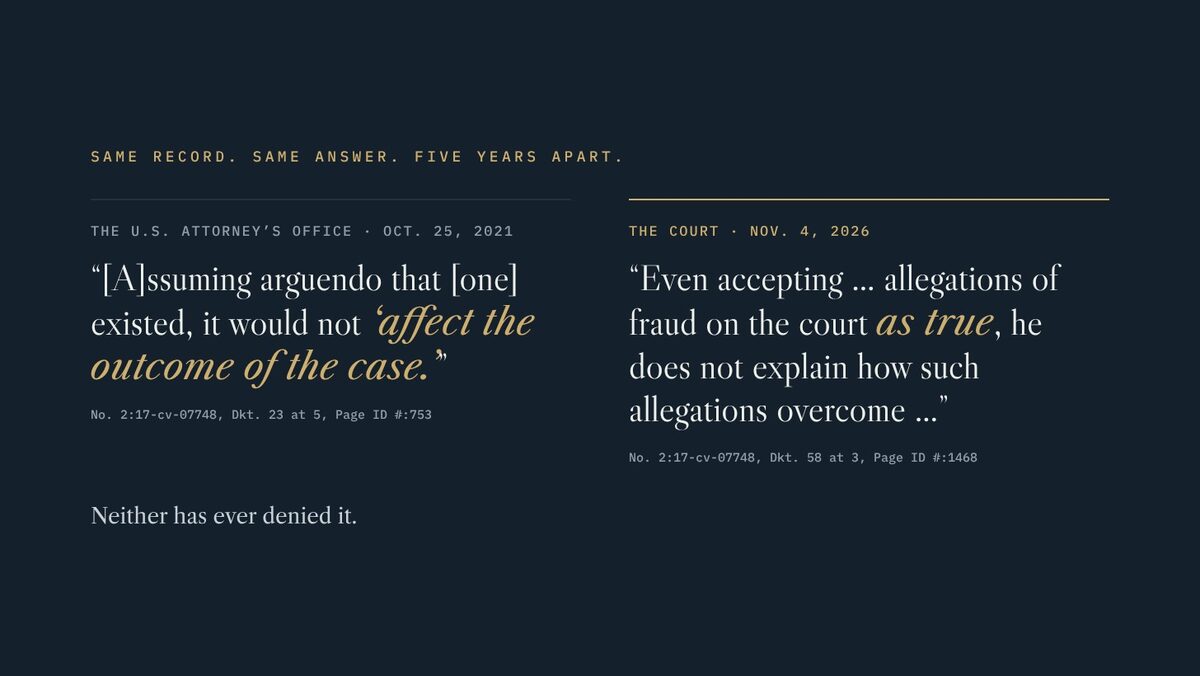
“Untimely”
The order also denied the motion as “untimely,” because the same grounds had been raised in 2021, in motions struck on local-rule grounds and never decided on the merits. (Dkt. 58 at 3, Page ID #:1468.)
There is no deadline for fraud on the court. Rule 60’s time limit governs only motions “under Rule 60(b).” Rule 60(d)(3) says the rule “does not limit a court’s power to … set aside a judgment for fraud on the court.” Fed. R. Civ. P. 60(c)(1), (d)(3). The Ninth Circuit calls that power “so free from procedural limitations.” United States v. Estate of Stonehill, 660 F.3d 415, 444 (9th Cir. 2011).
A fraud accepted as true was held too late to correct, under a rule that sets no deadline.
The hearing that never happened
That order is why the hearing set for Friday, November 6, 2026, never happened: “The Court therefore VACATES the hearings set for November 6 and 20, 2026.” (Dkt. 58 at 1.)
The same order struck six of the victim’s notices as “repetitive and unduly burdensome.” Each notice stated that it “requests no ruling and no relief beyond what the pending motions already seek.” Among them was the notice that placed before the Court a verified complaint of judicial misconduct concerning the prior judge, now docketed by the Ninth Circuit’s Circuit Executive as No. 26-90261.
The order then warned that “other rule violations, whether in this case or in his related cases, may be stricken.” (Dkt. 58 at 3 n.2, 4.) The “related cases” are the victim’s two pending petitions under the Crime Victims’ Rights Act, the very cases in which he asks for the rights the fraud took.
Friday, November 6: what the victim filed instead
On the day the hearing should have happened, the victim filed:
1. A new petition under the Crime Victims’ Rights Act, 18 U.S.C. § 3771(d)(3): In re Escamilla, No. 2:26-cv-13079-AB (C.D. Cal., filed Nov. 6, 2026).
It names the United States, the Department of Justice, and Judge Birotte, in his official capacity as a United States District Judge only. It seeks no money damages and no personal relief. It asks a court with authority to enforce the duties Congress placed on the courts themselves: the district court “shall take up and decide any motion asserting a victim’s right forthwith,” § 3771(d)(3), and “shall ensure that the crime victim is afforded the rights described in subsection (a),” § 3771(b)(1).
The victim’s first petition, No. 2:26-cv-05207, was filed May 14, 2026. On November 6 it had been pending 176 days, with no decision and no response ever required of the government. “The unexplained, three-month passage of time without a ruling by the district court does not comply with the statute.” In re Simons, 567 F.3d 800, 801 (6th Cir. 2009).
2. An Emergency Notice of Mandatory Disqualification, filed in both pending crime-victim cases (Nos. 2:26-cv-05207 and 2:26-cv-09383).
It rests on one objective fact: the presiding judge is now a named respondent. A judge “shall also disqualify himself” where he “[i]s a party to the proceeding.” 28 U.S.C. § 455(b)(5)(i). That ground cannot be waived. § 455(e). It requires no motion, no hearing, and no finding of bias. As the Notice says: “Petitioner does not contend that Judge Birotte is biased. He does not have to.”
3. A Notice of Related Cases, filed in No. 2:26-cv-13079-AB, asking that any related-case determination be made by the Chief Judge, as the Court’s own General Order 08-05, § 5.2, provides, and that no transfer place the new petition, or the cases it reviews, before the judge it names.
4. A letter to the Clerk of Court setting out the related-case record and asking that the case be processed under the Court’s own rules.
Every respondent was served by certified mail under Federal Rule of Civil Procedure 4(i): the U.S. Attorney’s Office, the Attorney General of the United States, and the judge.
It already happened once, in this same case
On August 21, 2026, the victim filed a crime-victim petition naming the prior judge, the Honorable Otis D. Wright II, as a respondent. On August 24 he applied to disqualify him. On August 26, Judge Wright recused himself under 28 U.S.C. § 455, fifty minutes after the application was entered on the docket. (No. 2:26-cv-05207, Dkts. 47, 49, Page ID #:1237.) In the 2017 case, he recused the day after the victim moved to disqualify him there. (No. 2:17-cv-07748, Dkts. 26, 30.)
The case went to Judge Birotte. On October 21, 2026, he ruled on that same application, denying it “as moot.” (No. 2:26-cv-05207, Dkt. 53, Page ID #:1379.)
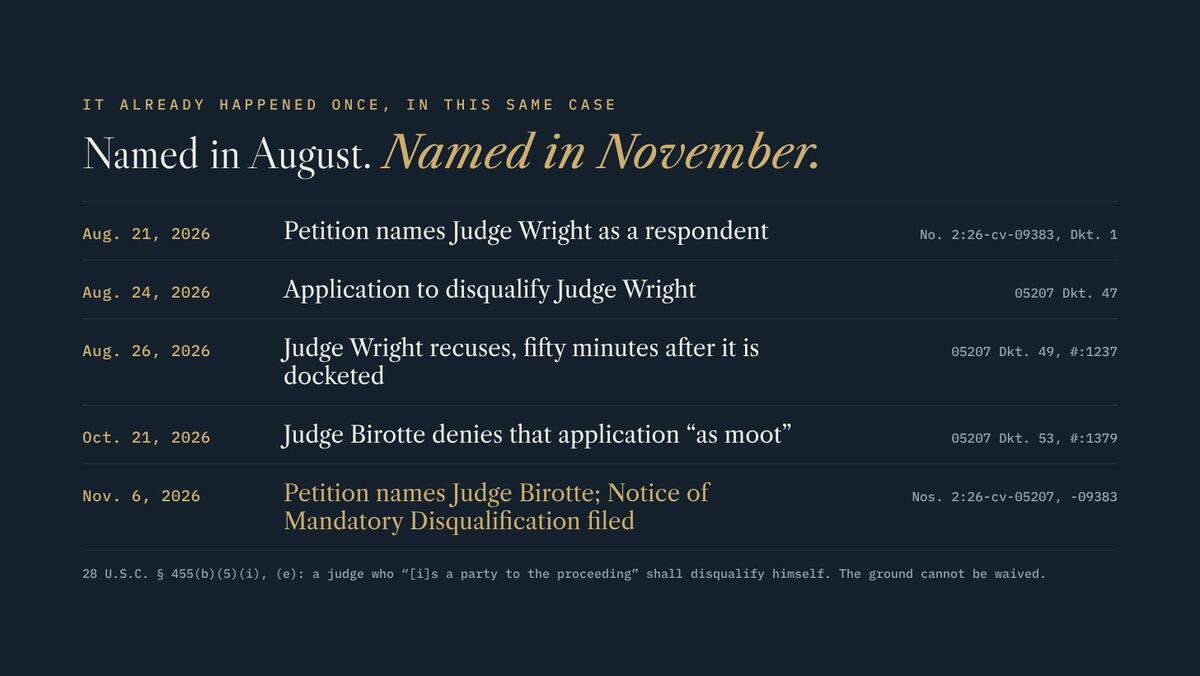
The rule that applied in August applies in November. As the Notice puts it: “He now stands where the prior judge stood.”
No role. No jurisdiction. No authority.
The crimes against Greenway were investigated by Homeland Security Investigations, Kansas City, and prosecuted in the Western District of Missouri. No judge of the Central District of California presided over that prosecution. The U.S. Attorney’s Office for the Central District of California did not prosecute it.
Yet every ruling ever entered against the victim’s status was entered here, by a court that said in writing it had no jurisdiction:
- 2018. Judge Wright dismissed the victim’s 2017 civil-rights case under 42 U.S.C. § 1983 and the Federal Tort Claims Act “for lack of subject matter jurisdiction.” That case asserted no right under the Crime Victims’ Rights Act. The same order recited the “extensive investigation for criminal trademark infringement,” that ICE and the U.S. Attorney’s Office “had recovered over $26 million in the investigation,” that the victims “may be able to recover from an established victims’ fund,” and that the U.S. Attorney’s Office in Missouri “agreed that Greenway would be added as a victim in the government’s case.” (No. 2:17-cv-07748, Dkt. 13 at 2, Page ID #:210.)
- 2021. When the victim petitioned under the Crime Victims’ Rights Act, the same judge reached back to that jurisdictional dismissal and faulted the victims for having “failed to specifically identify a criminal proceeding,” in an order that quoted their identification of the sealed case against “SELAKOVIC, BLACKBURN and others” in “the Western District of Missouri.” He called their account “merely speculation pulled from the ether.” (No. 2:21-cv-01910, Dkt. 10 at 1–2, Page ID #:293–294.) The government never appeared.
- 2026. The November 4 order accepted the fraud as true and rested, by its own words, on “this Court’s lack of subject matter jurisdiction.”
So here is the principle:
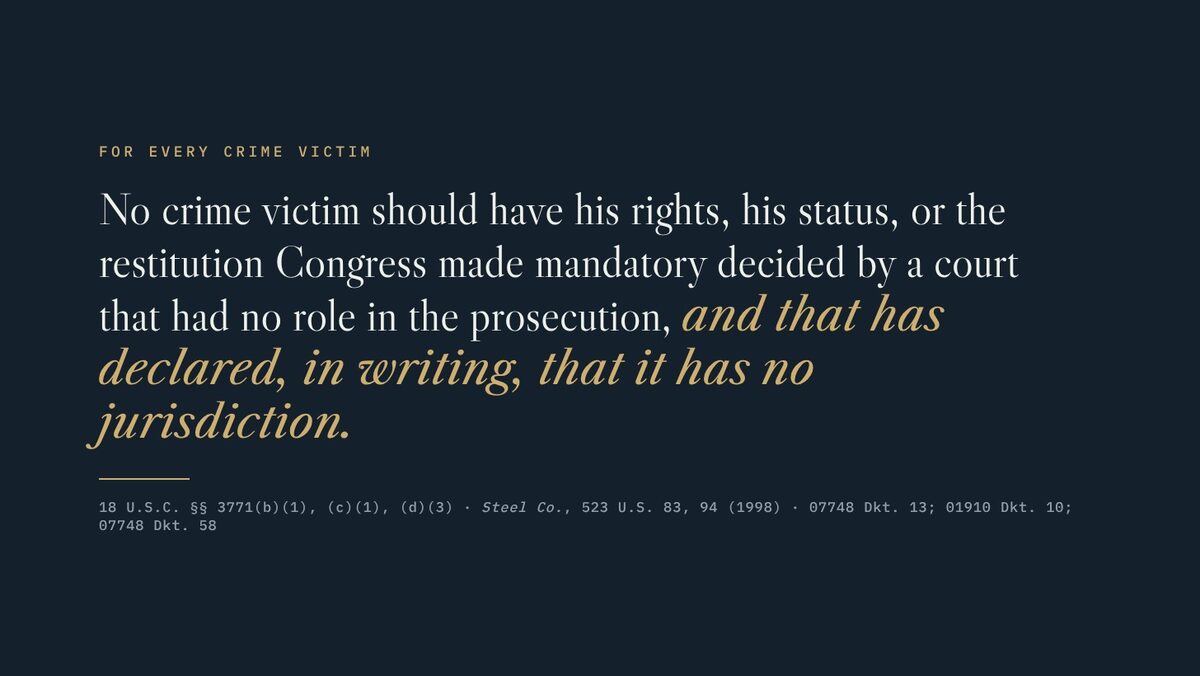
No crime victim should have his rights, his status as a victim, or the restitution Congress made mandatory decided by a court that had no role in the prosecution, and that has itself declared, in writing, that it has no jurisdiction.
A victim’s rights do not attach by leave of a court with no connection to the case. They attach through the officers “engaged in the detection, investigation, or prosecution of crime,” who “shall make their best efforts to see that crime victims are notified of, and accorded,” their rights. 18 U.S.C. § 3771(c)(1).
Here, a DHS special agent identified Greenway as a lead victim, and the Missouri office agreed to add it to the government’s case. The government’s own motion put those facts before the Court. (No. 2:17-cv-07748, Dkt. 13 at 2–3, Page ID #:210–211.)
The Ninth Circuit has refused to let a government officer who “forged and submitted evidence” in a federal proceeding “cloak himself in the government’s protection.” Lanuza v. Love, 899 F.3d 1019, 1028–29 (9th Cir. 2018).
What every crime victim should know
The victim in this story is not a lawyer. Everything he has filed, he filed by learning the rules. These rules are yours too.
Your rights under the Crime Victims’ Rights Act, 18 U.S.C. § 3771(a):
- to be reasonably protected from the accused;
- to reasonable, accurate, and timely notice of court proceedings;
- to be reasonably heard;
- to confer with the attorney for the government;
- to full and timely restitution as provided in law;
- to proceedings free from unreasonable delay;
- to be treated with fairness and with respect for your dignity and privacy.
The court’s duty. “[T]he court shall ensure that the crime victim is afforded the rights described in subsection (a).” § 3771(b)(1).
The government’s duty. DOJ and every agency “engaged in the detection, investigation, or prosecution of crime shall make their best efforts” to see that you are notified of, and accorded, those rights. § 3771(c)(1).
How to enforce them. You may assert your rights by motion in the district court where the defendant is being prosecuted or, “if no prosecution is underway,” where the crime occurred, and the court “shall take up and decide” it “forthwith.” § 3771(d)(3). If relief is denied, you may petition the court of appeals for a writ of mandamus, and that court “shall take up and decide such application forthwith within 72 hours.” Id.
In the Ninth Circuit, In re Davis, Nos. 24-3090 & 24-3092, 146 F.4th 710 (9th Cir. 2025) (as amended Aug. 1, 2025), confirms that path, including for post-judgment restitution petitions under 18 U.S.C. § 3664(d)(5).
Restitution is not a favor. For an offense “committed by fraud or deceit,” restitution is mandatory. 18 U.S.C. § 3663A(c)(1)(A)(ii). “[N]o victim shall be required to participate in any phase of a restitution order.” § 3664(g)(1).
The rules of judicial conduct belong to you, too:
- A judge who is a party must step aside. § 455(b)(5)(i). The ground cannot be waived. § 455(e).
- A judge must step aside whenever “his impartiality might reasonably be questioned.” § 455(a). What matters “is not the reality of bias or prejudice but its appearance.” Liteky v. United States, 510 U.S. 540, 548 (1994).
- Judges must act on reliable information of misconduct. A judge “should take appropriate action upon receipt of reliable information indicating the likelihood that a judge’s conduct contravened this Code … or that a lawyer violated applicable rules of professional conduct.” Code of Conduct for U.S. Judges, Canon 3B(6).
- Anyone may file a complaint of judicial misconduct with the clerk of the court of appeals. 28 U.S.C. § 351(a).
- A judgment procured by fraud on the court can be set aside at any time. Fed. R. Civ. P. 60(d)(3).
And the practical rules the victim learned the hard way:
- Put everything in writing. Ask the government to confer in writing, with a deadline. Keep the record of every unanswered request.
- Read your court’s General Orders and Local Rules. Related-case assignments, transfers, and page limits are where victims lose rights quietly.
- Read the docket yourself. Quote it exactly. Cite the page.
- Never accept that a court with no jurisdiction can decide your rights. Say so, on the record, with the citation.
Read the record yourself
Every document described here is public. The Emergency Notice of Mandatory Disqualification and Exhibits A through D, as filed on November 6, are in one folder, each one downloadable:
→ The November 6 filings: gustavoescamilla.com/nov-6
- The Notice (36 pp.), Emergency Notice of Mandatory Disqualification, No. 2:26-cv-05207. The same Notice was filed in No. 2:26-cv-09383.
- Exhibit A, the first page of the new petition naming the presiding judge in his official capacity, now No. 2:26-cv-13079-AB.
- Exhibit B, the November 4, 2026 order (No. 2:17-cv-07748, Dkt. 58), in full. Read page 3 for yourself.
- Exhibit C, the August 24 application to disqualify the prior judge, and his August 26 recusal (No. 2:26-cv-05207, Dkts. 47, 49).
- Exhibit D, the October 21, 2026 order denying that application “as moot” (No. 2:26-cv-05207, Dkt. 53).
Don’t take anyone’s word for it. Not the government’s. Not the victim’s. Read the orders. Then ask whether any crime victim in America should have his rights decided this way.
Why this matters beyond one case
The victim was told he had no voice. This is it, on the public docket, under penalty of perjury, citing every page.
If a fraud on the court can be accepted as true and still be held not to matter, against a federally identified lead victim in one of the government’s largest counterfeit prosecutions, it can happen to anyone. And if one victim can stand up, in pro per, with nothing but the statute, the rules, and the record, so can you.
“I can do all things through Christ who strengthens me.” — Philippians 4:13
This article describes filings made by a self-represented crime victim in pending federal litigation. The petition and notices reflect his position; no court has made findings on their contents. Court orders are quoted as entered. Nothing here is legal advice. If you are a crime victim, consult a lawyer or a victims’ rights organization about your own situation.