THE MOTION
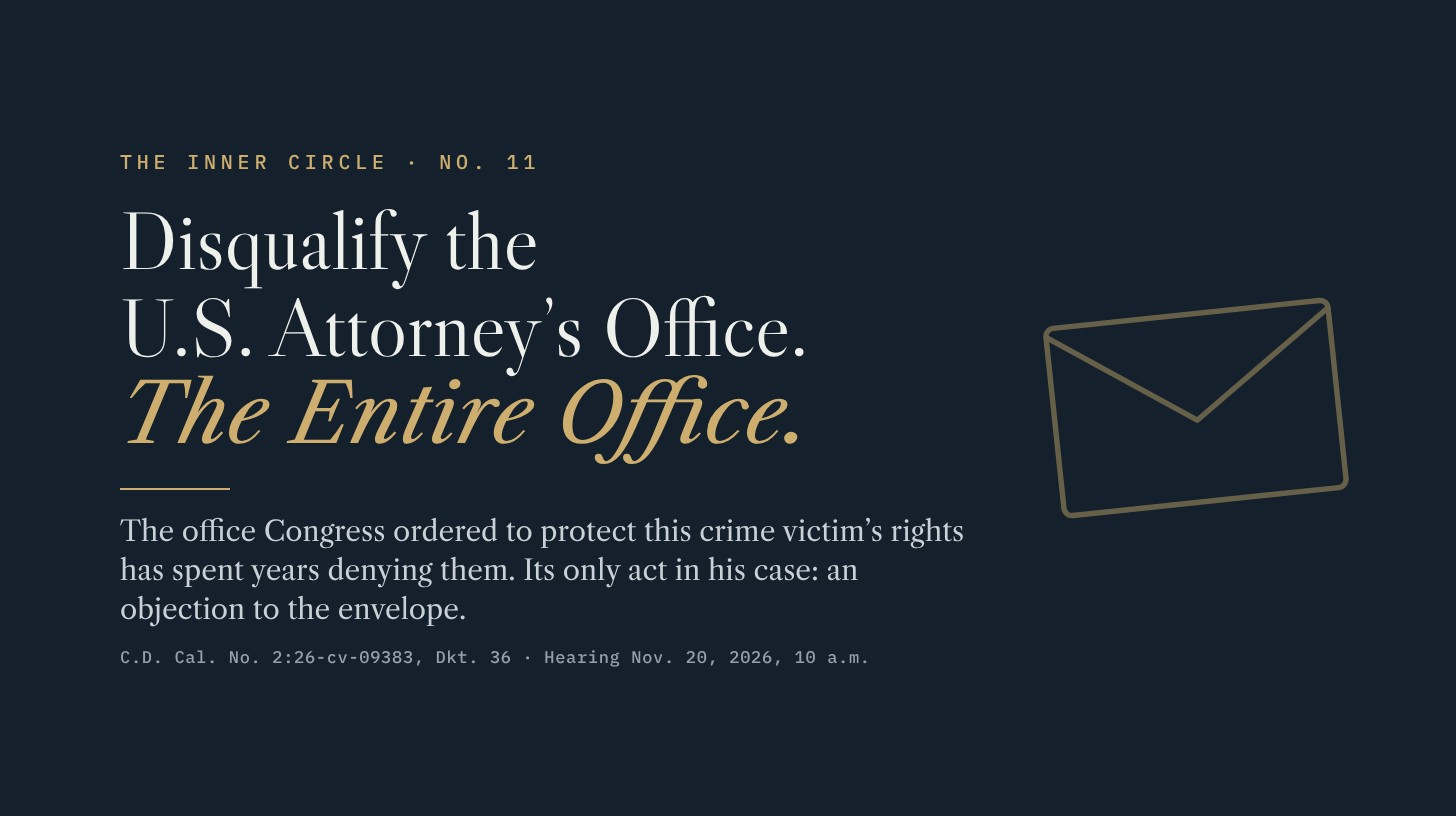
On October 14, 2026, the victims filed an Emergency Motion asking the U.S. District Court for the Central District of California to order:
That the U.S. Attorney’s Office for the Central District of California be disqualified from representing the United States in their crime-victim case. It would be barred from filing any response or other paper, and from contacting the victims except through substitute counsel.
In the alternative, that the United States be represented by Department of Justice attorneys from outside both that Office and the U.S. Attorney’s Office for the Western District of Missouri, “with every attorney and official of the Office who participated in, or received written notice of, the conduct… screened from this proceeding.”
Any further relief needed “to protect the integrity of this proceeding.”
(No. 2:26-cv-09383, Dkt. 36 at 2.)
The hearing is set for Friday, November 20, 2026, at 10:00 a.m., in Courtroom 7B of the First Street U.S. Courthouse, Los Angeles. The Crime Victims’ Rights Act requires that a victim’s motion be decided “forthwith,” so the victims have also asked the court to decide it sooner, on the papers. (Id. at 2–3; 18 U.S.C. § 3771(d)(3).)
THE QUESTION
The motion opens with one question:
“whether the United States Attorney’s Office may defend, against a federally identified crime victim, its own failure to accord him the rights that the same statute commands it to accord.” (Dkt. 36 at 6.)
ONE OFFICE, TWO JOBS
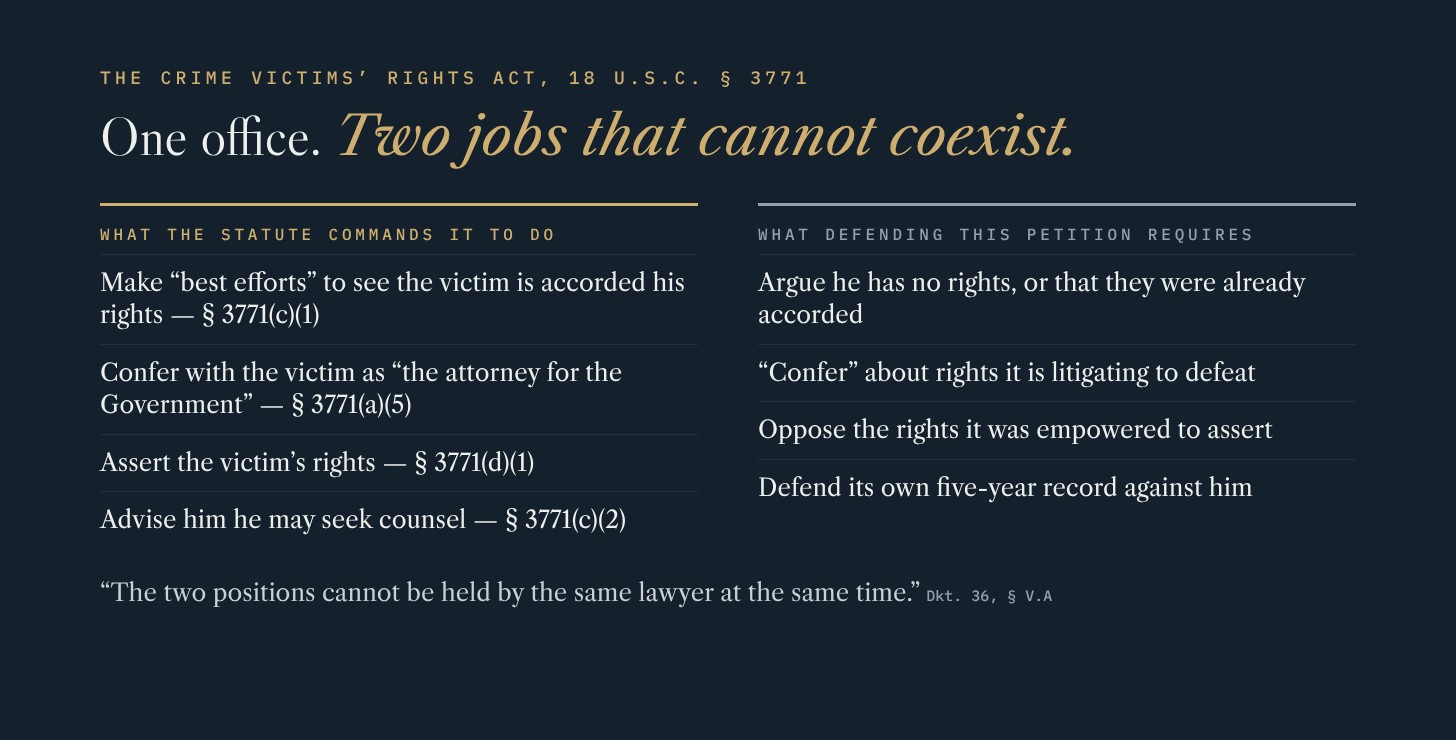
Under the Crime Victims’ Rights Act, the U.S. Attorney’s Office isn’t a neutral party. Its attorneys:
“shall make their best efforts to see that crime victims are notified of, and accorded,” their rights (18 U.S.C. § 3771(c)(1));
are the “attorney for the Government” with whom the victim has a right to confer (§ 3771(a)(5));
are one of only two parties the law empowers to “assert the rights” of a victim (§ 3771(d)(1)).
The motion’s core argument is that the Office “cannot make best efforts to accord the victim his rights while arguing that he has none, or that it has already accorded them. The two positions cannot be held by the same lawyer at the same time.” (Dkt. 36, § V.A.)
It adds: “A right to confer with the party whose non-compliance is the subject of the dispute is no right at all.” (Id.)
According to the motion, this is not a future risk: “That is not an appearance of conflict… It is a ‘clear legal… violation’… produced by the representation itself.” (Id.)
THE STANDARD THE OFFICE ITSELF STATED
The Ninth Circuit calls disqualifying an entire U.S. Attorney’s Office “an extreme remedy — only appropriate in the most extraordinary circumstances.” (United States v. Williams, 68 F.4th 564, 573 (9th Cir. 2023).)
On December 8, 2025, the same Office, under First Assistant U.S. Attorney Bilal A. Essayli, told another judge of the same court what that showing requires: “a clear basis in fact and law” demonstrating “a violation of the Constitution, a federal statute, or a procedural rule.” (United States v. Banks, No. 2:24-cr-00621-MWF, ECF No. 319.)
The victims accept that standard. “[H]e meets it with a federal statute and with documents. Every fact below is a filing, an order, or a letter that bears a docket number or a date.” (Dkt. 36 at 9.)
THE RECORD BEHIND IT
According to the motion, the conflict “began with a fabricated court ruling that no court ever made.” It sets out what followed:
“A DHS agent reported it, and it suspended the Lead Victim’s participation in an active federal criminal investigation. The Office carried it into this District under the signature of the United States Attorney.”
“When Petitioner proved it false under oath, the Office did not correct it; it took up his status as a crime victim and denied it, on a recast version of the same fabrication.”
“When Petitioner moved to set aside the Judgment it produced, the Office did not deny the fraud; it assumed it ‘arguendo’ and told the court it would not matter.”
When the victims gave the Office written notice and asked for protection, its Victim-Witness unit replied: “It does not appear that you are an identified crime victim in a federal criminal proceeding… We cannot assist you.”
(Dkt. 36 at 6–7.)
In the motion’s words: “Each act built on the last… It is not a series of oversights. It is a course of conduct.” (Id. at 7.)
NOT EVEN ITS CASE
“The Office did not investigate Operation Software Slashers, did not charge it, did not prosecute it, had no oversight of or authority over it, and was not at the table in Burbank, California, where federal agents identified Petitioner’s company as its Lead Victim… An office with no oversight of that prosecution, no role in it, and no authority over it has spent years telling the victim who was in the room that he was never a victim at all.” (Dkt. 36 at 8.)
ITS ONLY ACT: THE ENVELOPE
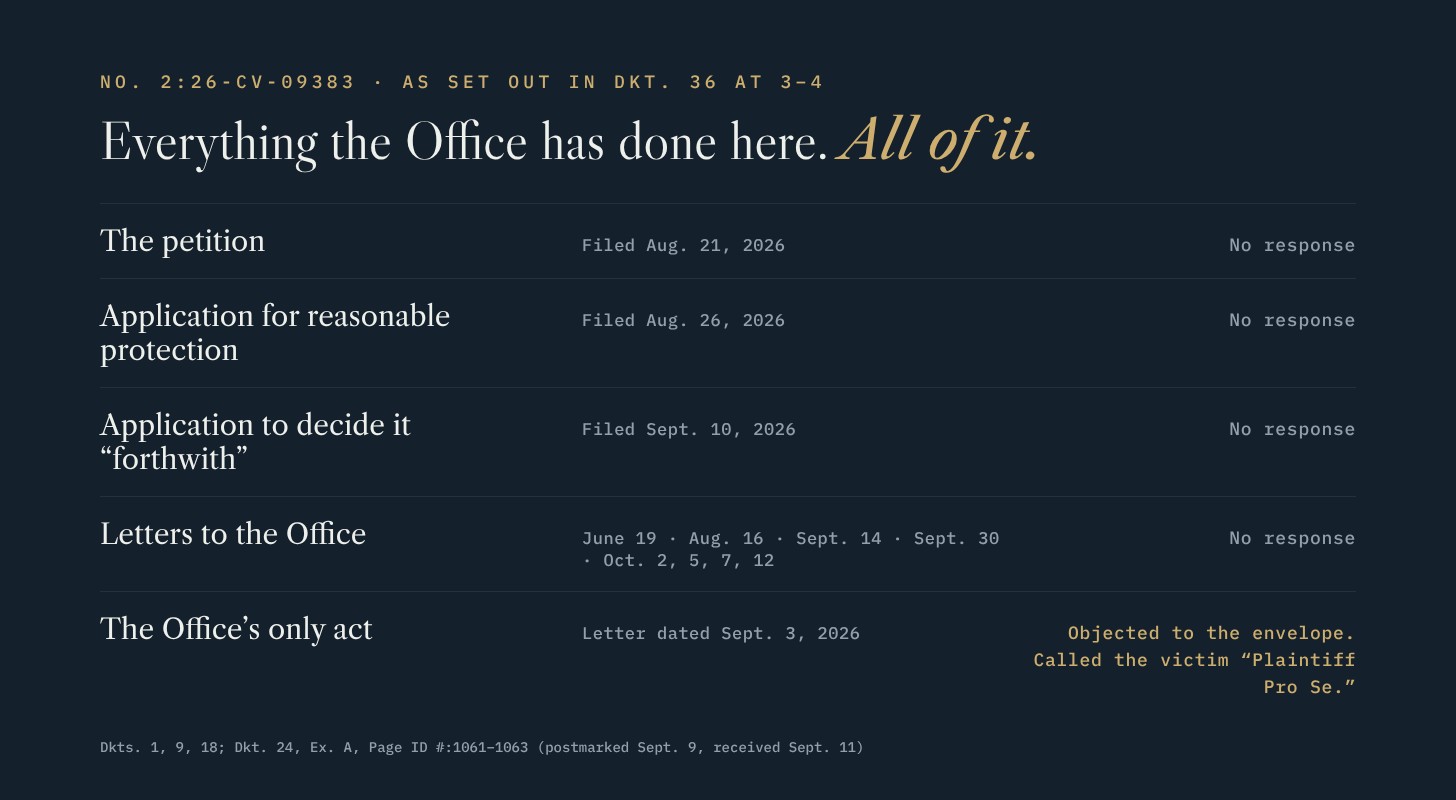
The Office filed no response to the victims’ petition, their application for reasonable protection, or their application to decide the case “forthwith.” (Dkts. 1, 9, 18.)
Its only act in the case was a letter dated September 3, 2026. The letter “objected to the envelope in which the Office was served, and it addressed the federally identified crime victim as ‘Plaintiff Pro Se.’” (Dkt. 36 at 4; Dkt. 24, Ex. A.)
The victims wrote to the Office nine times, offering to confer in writing or by video: on June 19, August 16, September 14 and September 30, and on October 2, 5, 7 and 12. None of those letters was answered. (Dkt. 36 at 4–5.)
WHY SCREENING ISN’T ENOUGH
Department rules require employees to report allegations of attorney misconduct. They “have a duty to, and shall, report.” (28 C.F.R. § 45.12; Justice Manual § 1-4.300.)
The motion shows that the allegations reached every supervisory level, from the First Assistant on December 18, 2025, to the Civil Division chiefs in August and September 2026. “Not one of those officials has stated that the allegations were evaluated, referred, or reported.” (Dkt. 36, § V.D.)
In the motion’s words, a screen run by those same supervisors “would not cure the conflict.” (Id.)
THE OFFICE’S OWN PROCEDURE
The Department already has a rule for this. “United States Attorneys cannot recuse themselves or their offices”; when a conflict arises, the office “must contact EOUSA’s General Counsel’s Office,” which “will coordinate the recusal action… and arrange for a transfer of responsibility to another office.” (Justice Manual § 3-1.140.)
“It is the Office’s own procedure, and the Office has not invoked it.” (Dkt. 36, § V.E.)
The motion leaves the choice of substitute counsel to the Department and asks for nothing that touches a charging decision. (Id.; 18 U.S.C. § 3771(d)(6).)
OUTLASTED
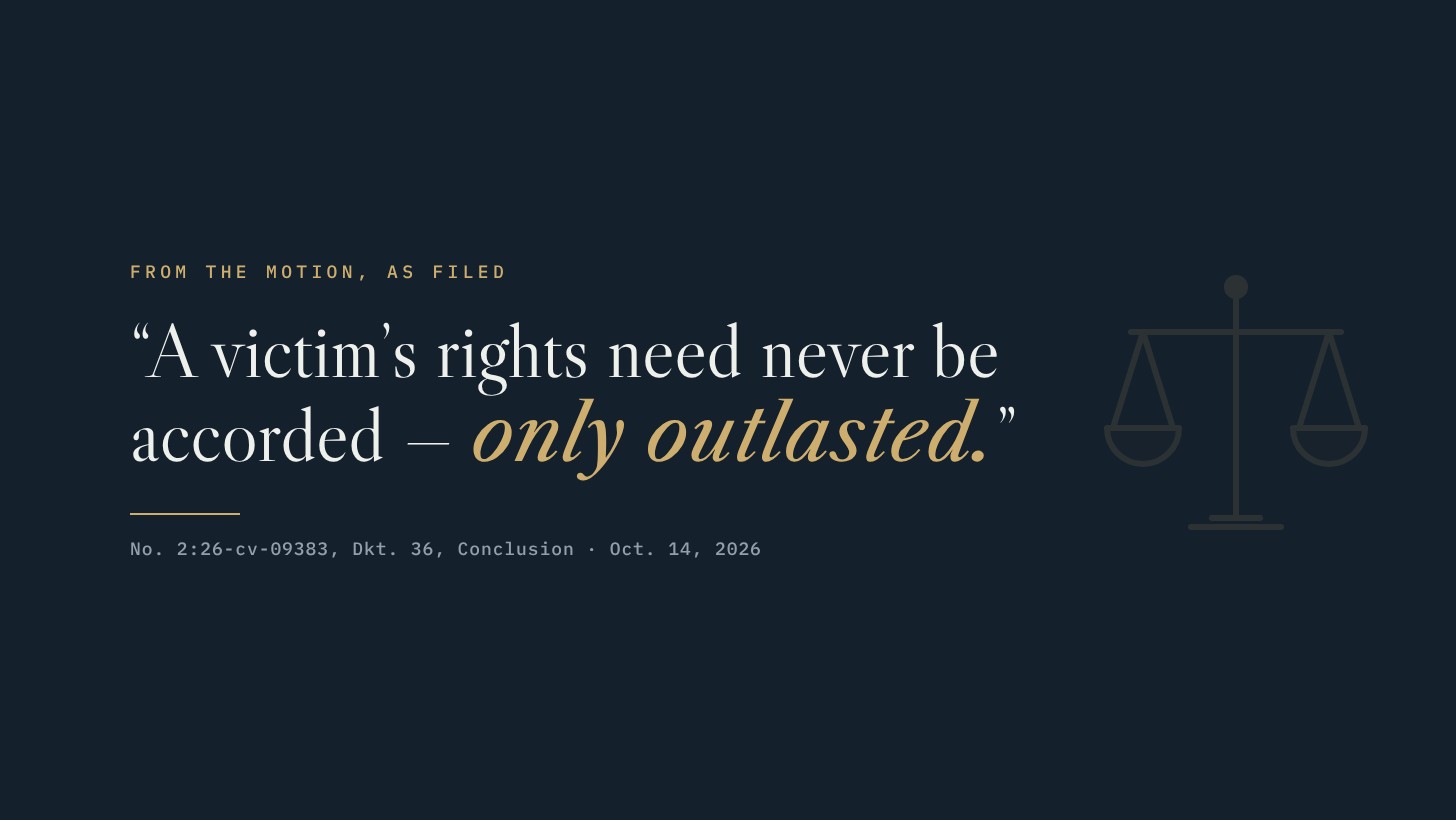
“If the Office that carried the fabrication into this District, and that has met this victim only with denials, referrals elsewhere, and an objection to an envelope, may now answer his Petition to enforce those rights, the lesson is plain: a victim’s rights need never be accorded — only outlasted.” (Dkt. 36, Conclusion.)
Disqualify the entire office: the hearing is November 20. If you don’t believe it, read it for yourself.
The record (available on PACER):
No. 2:26-cv-09383 (C.D. Cal.), Dkts. 1, 2-1, 9, 18, 24, 36
No. 2:17-cv-07748 (C.D. Cal.), Dkts. 15, 23 (companion motion filed the same day)
United States v. Williams, 68 F.4th 564 (9th Cir. 2023)
United States v. Banks, No. 2:24-cr-00621-MWF (C.D. Cal.), ECF No. 319
This article summarizes and quotes filings on the public docket. It reflects the victims’ position as self-represented petitioners. No court has ruled on the motion. Nothing here is legal advice, and nothing here waives any right under the Crime Victims’ Rights Act or the Federal Tort Claims Act.