“A FORGERY IS STILL A FORGERY”
In 2013, Judge Otis D. Wright II confronted a single forged signature on a copyright assignment in Ingenuity 13 LLC v. Doe. His order opened: “The needs of the many outweigh the needs of the few.”
In that order, Judge Wright:
wrote that the court “has a duty to supervise the conduct of attorneys appearing before it”;
held that “a forgery is still a forgery”;
found “brazen misconduct and relentless fraud”;
referred the attorneys to their bars, to the U.S. Attorney, to IRS Criminal Investigation, and to this District’s Standing Committee on Discipline.
(No. 2:12-cv-08333-ODW, ECF No. 130 at 3, 8, 10–11; as cited in No. 2:26-cv-09383, Dkt. 44 at 14–15.)
That is what Canon 3B(6) of the Code of Conduct for United States Judges contemplates. A judge “should take appropriate action upon receipt of reliable information indicating the likelihood… that a lawyer violated applicable rules of professional conduct.” (Dkt. 44 at 15.)
THEN CAME THIS RECORD
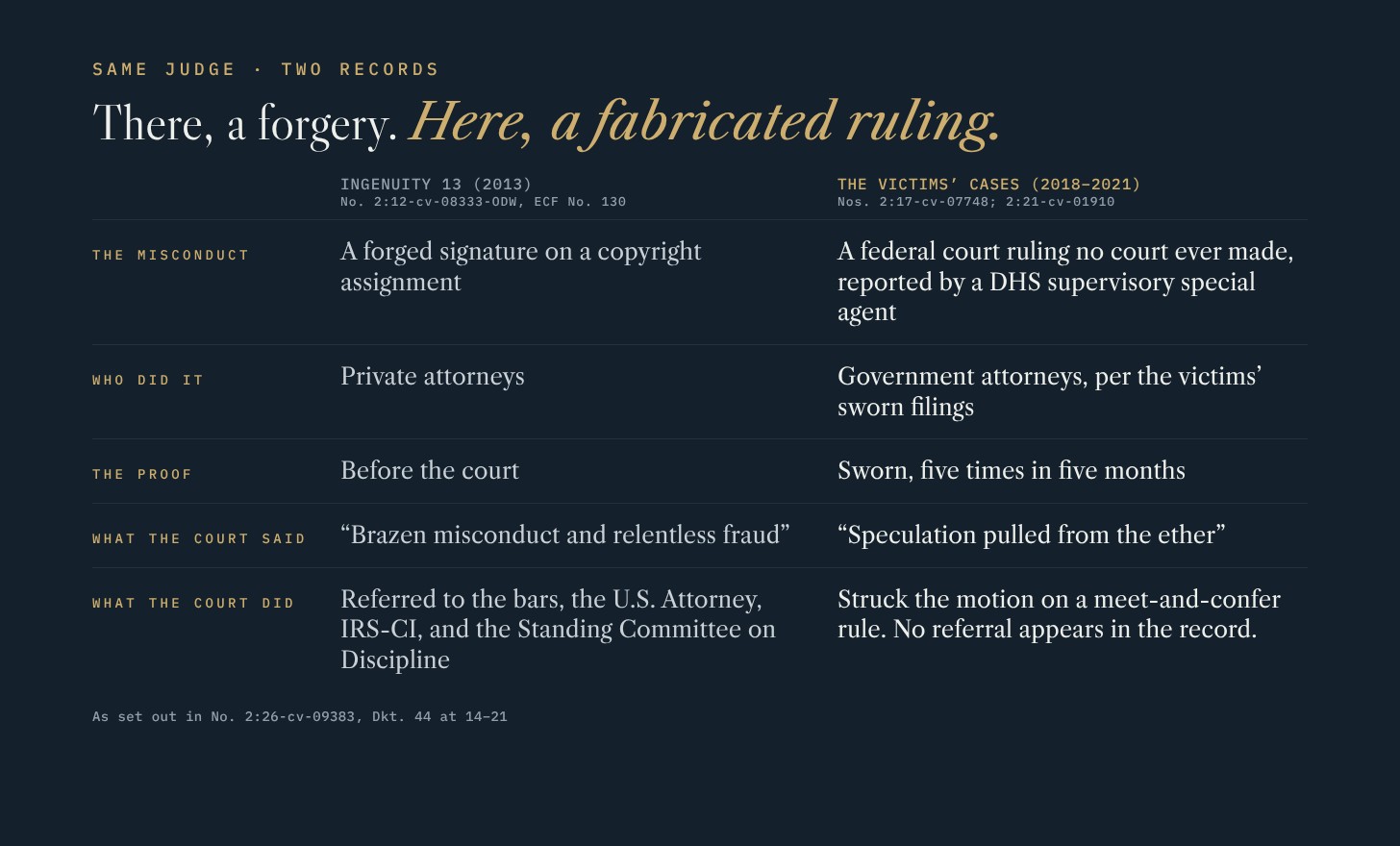
The forgery: Here it wasn’t a signature. It was a federal court ruling that never existed, reported in writing by a DHS supervisory special agent from his government email account: “a District Court found in favor of Selakovic against Greenway Nutrients.” (No. 2:17-cv-07748, Dkt. 1, Ex. 9.)
The real ruling: The Colorado court ruled the other way: “The Court disagrees.” As the victims’ filing puts it: “He did not misread the docket. He inverted it.” (Dkt. 44 at 10.)
2018: Judge Wright dismissed the victims’ case on “the negative judgment in the Colorado action.” (Dkt. 13 at 13.)
2021: The victims proved under oath that the ruling never existed. Judge Wright called their account “speculation pulled from the ether.” (No. 2:21-cv-01910, Dkt. 10.)
The government’s answer: It didn’t deny the fraud. It assumed it “arguendo” and called it harmless. (Dkt. 23 at 5.)
November 9, 2021: That morning, the victims sent State Bar complaints against the U.S. Attorney’s Office attorneys. Later that day, Judge Wright struck their motion on meet-and-confer and page-limit grounds, “without a word on its substance.” In the filing’s words: “No referral appears in the record.” (Dkt. 44 at 20–21; No. 2:17-cv-07748, Dkt. 25.)
THE CLOSED LOOP
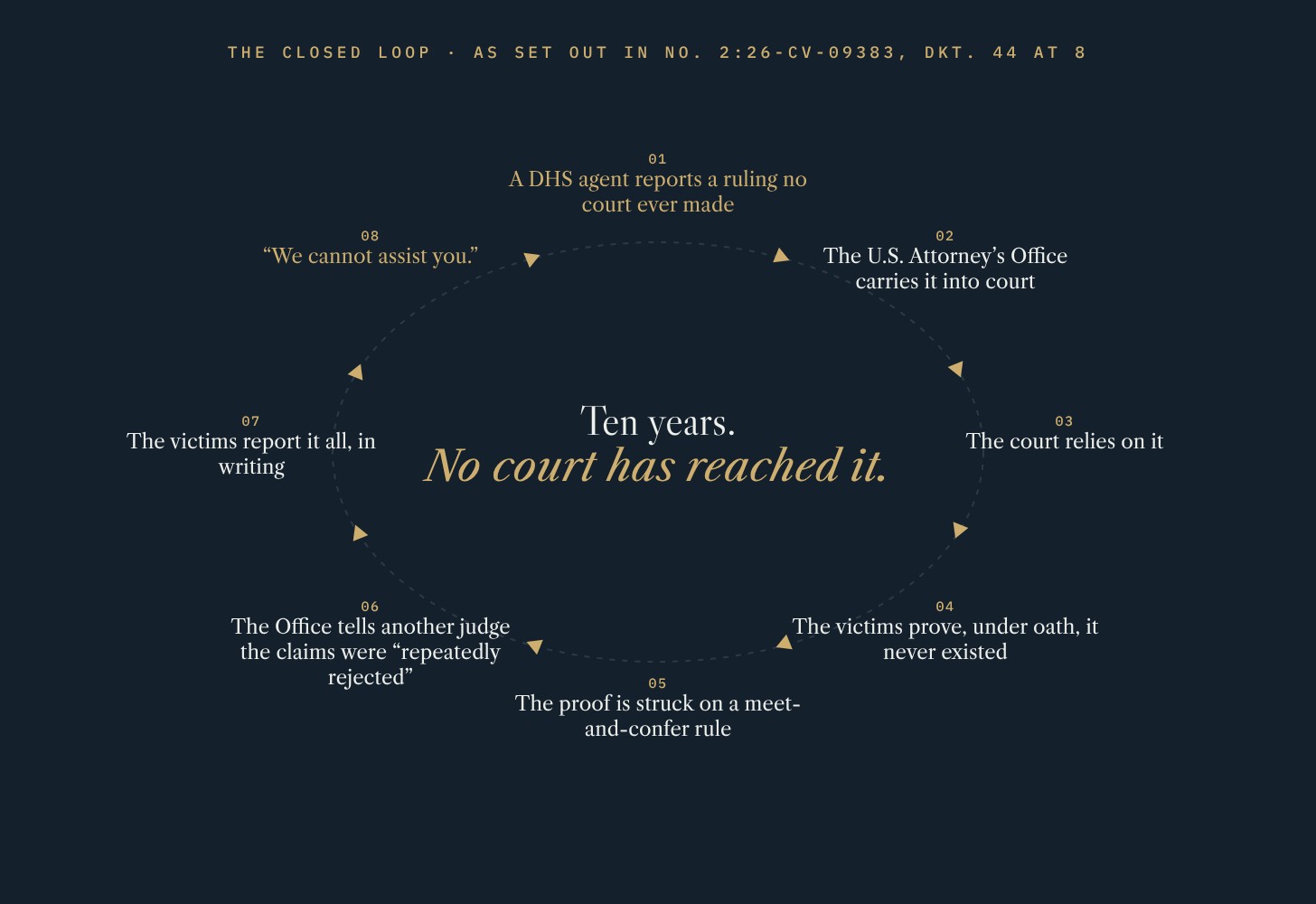
The victims’ filing describes it in one paragraph:
“A DHS supervisory special agent… report[s], in writing, a court ruling that no court ever made… The Office carries that fabrication into this Court. The Court relies on it. The victim proves, under oath, that the ruling never existed… The proof is struck on a Local Rule 7-3 ‘meet and confer’ objection, without a word on its substance. The Office then tells a third federal judge that the victim’s claims have been ‘repeatedly rejected.’ And when the victim reports all of it to the Office in writing… the Office answers: ‘We cannot assist you.’” (Dkt. 44 at 8.)
THE APPEAL THAT COULDN’T REACH IT
The Ninth Circuit affirmed the 2021 dismissal on law-of-the-case grounds. It described the attorney wrongdoing the victims raised as conduct “that occurred in a different action.” (Escamilla v. United States, No. 21-55417, 2022 WL 874647, at *1 (9th Cir. Mar. 24, 2022).)
That “different action” was the 2017 case, where the proof had just been struck, not decided.
In the filing’s words: “the misconduct could not be reached on appeal because it occurred in ‘a different action,’ and it was never reached in that different action because it was struck.” (Dkt. 44 at 21–22.)
FOUR VERSIONS OF ONE LIE, THREE ADMINISTRATIONS
YearVersion2016A ruling “in favor of Selakovic” (the DHS agent)2018Trademark ownership “in doubt” (under U.S. Attorney Nicola T. Hanna)2021The suit “did not reach a judgment on the merits” (under Acting U.S. Attorney Tracy L. Wilkison)2026Claims “courts have repeatedly rejected” (under First Assistant U.S. Attorney Bilal A. Essayli)
(Dkt. 44 at 9–13.)
The victims’ filing answers the last one in two sentences: “Allegations that no court has reached and the accused has never denied have not been ‘repeatedly rejected.’ They have been repeatedly avoided.” (Id. at 19.)
WHAT THE VICTIMS ASK
Nothing about the judge. The filing “requests no finding concerning Judge Wright,” because complaints about a judge belong to the Ninth Circuit. (Dkt. 44 at 7, 14.)
What it asks of the U.S. Attorney’s Office is simple: say whether it forwarded the January 23, 2026 misconduct report to the Department’s Office of Professional Responsibility, as the Justice Manual requires. If it didn’t, say who decided not to. (Id. at 6.)
The Office let the deadline pass without a word. (Id.)
In 2013: “A forgery is still a forgery.” In 2021: “Speculation pulled from the ether.” If you don’t believe it, read it for yourself.
The record (available on PACER):
No. 2:26-cv-09383 (C.D. Cal.), Dkt. 44
No. 2:17-cv-07748 (C.D. Cal.), Dkts. 1, 13, 23, 25
No. 2:21-cv-01910 (C.D. Cal.), Dkt. 10
Ingenuity 13 LLC v. Doe, No. 2:12-cv-08333-ODW (C.D. Cal.), ECF No. 130
Escamilla v. United States, No. 21-55417 (9th Cir. 2022)
This article summarizes and quotes filings on the public docket. It reflects the victims’ position as self-represented petitioners. No court or judicial council has made findings on these matters. Nothing here is legal advice, and nothing here waives any right under the Crime Victims’ Rights Act or the Federal Tort Claims Act.