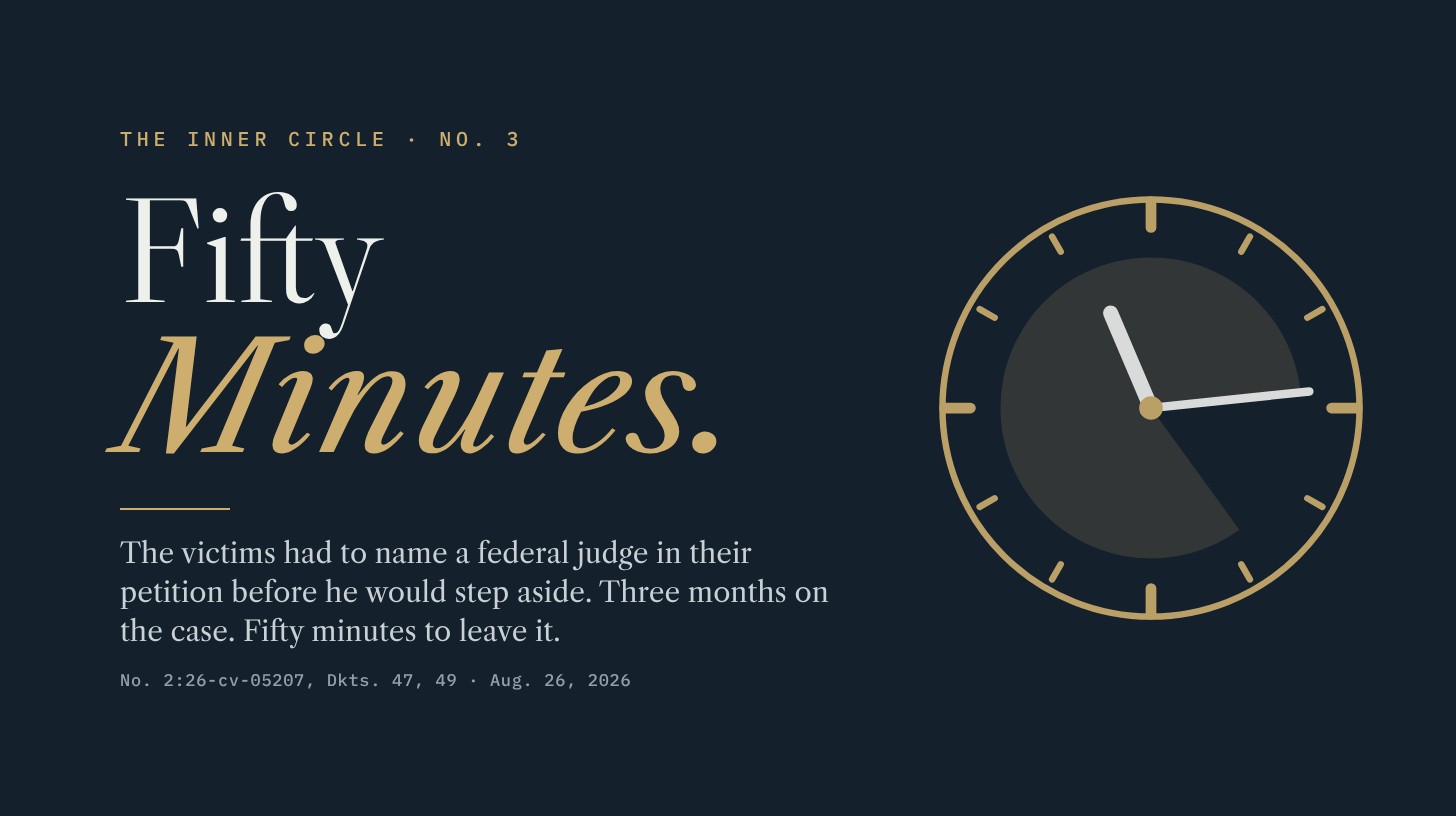

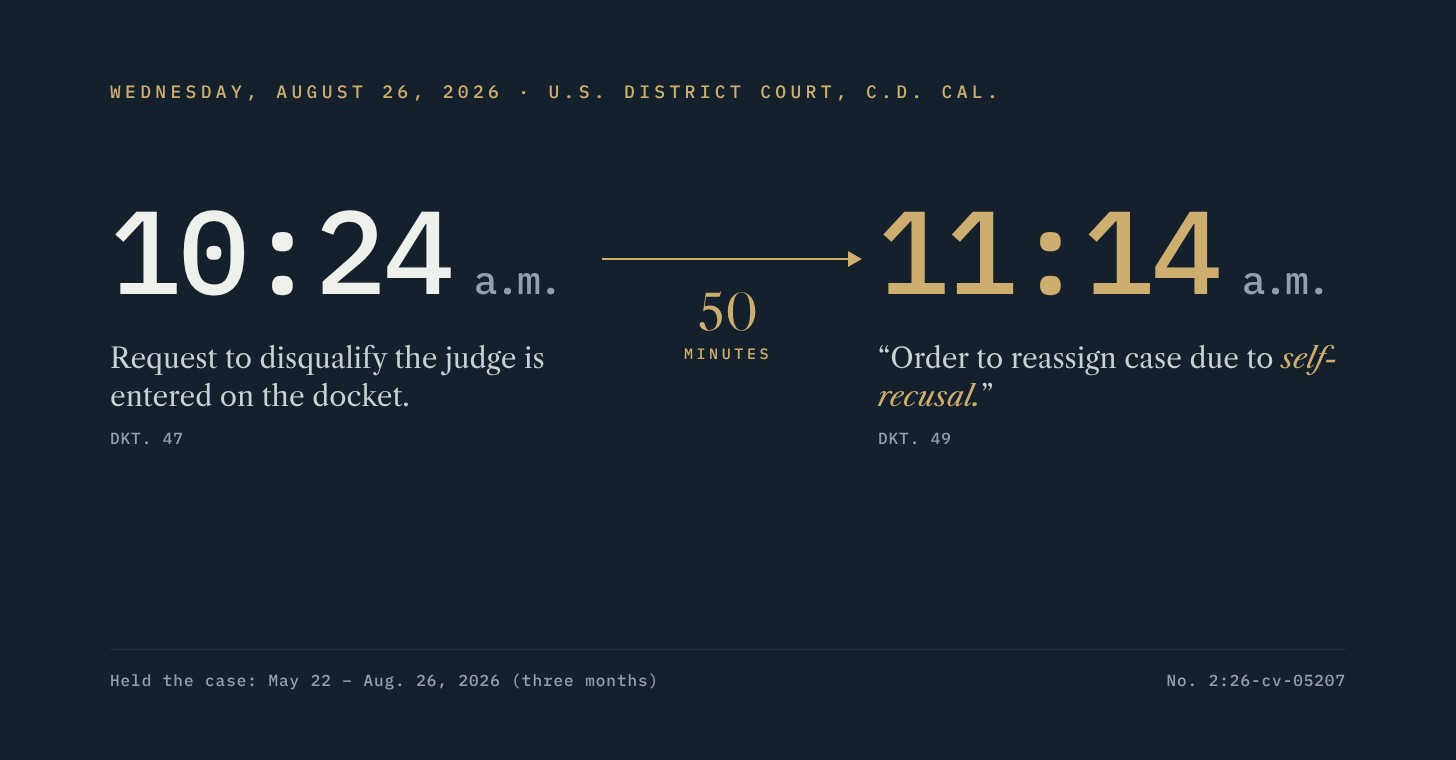
10:24 a.m., Wednesday, August 26, 2026. A request to disqualify the judge is entered on the docket. The judge is now a named Respondent in the victims’ own petition.
11:14 a.m. The court enters a one-page order: “ORDER TO REASSIGN CASE due to self-recusal.” The case goes to another judge “for all further proceedings.”
Fifty minutes. He had held the case for three months, and it ended in under an hour.
(No. 2:26-cv-05207, Dkt. 47; Dkt. 49, Aug. 26, 2026.)

In March 2015, federal agents sat down with the victims in Burbank in a recorded meeting. They identified the victims’ company as a Lead Victim in Operation Software Slashers, a federal counterfeit prosecution brought in the Western District of Missouri.
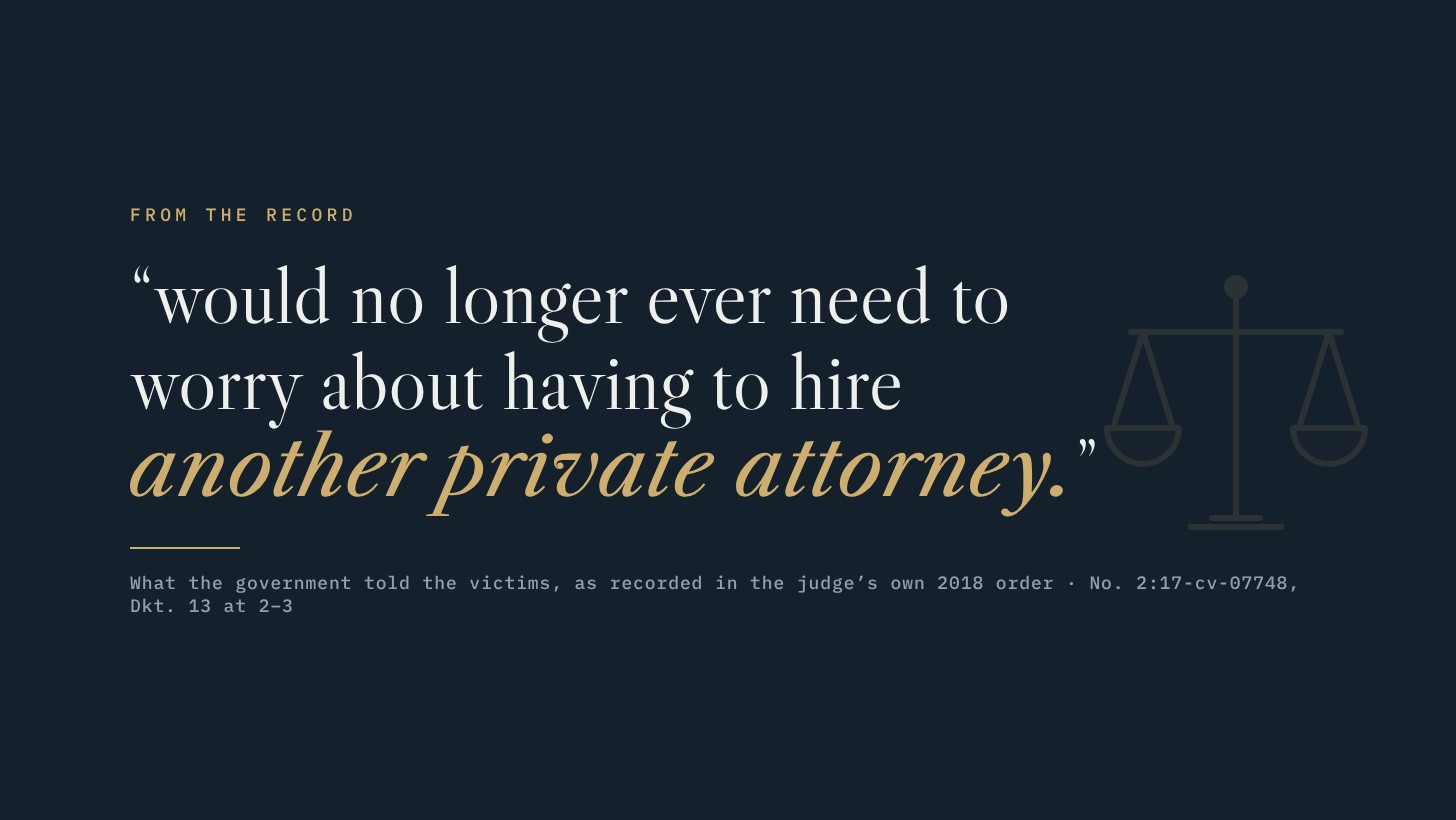
The federal judge’s own 2018 order recorded what the government had told the victims:
more than $26 million recovered;
an “established victims’ fund”;
an agreement to add the company as a victim;
and that the victims “would no longer ever need to worry about having to hire another private attorney.”
(No. 2:17-cv-07748, Dkt. 13 at 2–3.)
In October 2016, a DHS agent wrote that a Colorado court had “found in favor of Selakovic against Greenway Nutrients in regards to the assertion of the Greenway trademark.”
No court ever ruled that way. Chief Judge Krieger’s actual ruling: “The Court disagrees.”
The investigation as to the victims was suspended anyway.
(No. 2:26-cv-09383, Dkt. 1, Ex. D.)
[IMAGE: No3_act_act3.jpg]
2018: In the victims’ civil rights case, the federal judge held that his court lacked subject-matter jurisdiction.
2021: The victims filed a petition under the Crime Victims’ Rights Act. The same judge reached back to that 2018 case and declared:
that there was no criminal proceeding;
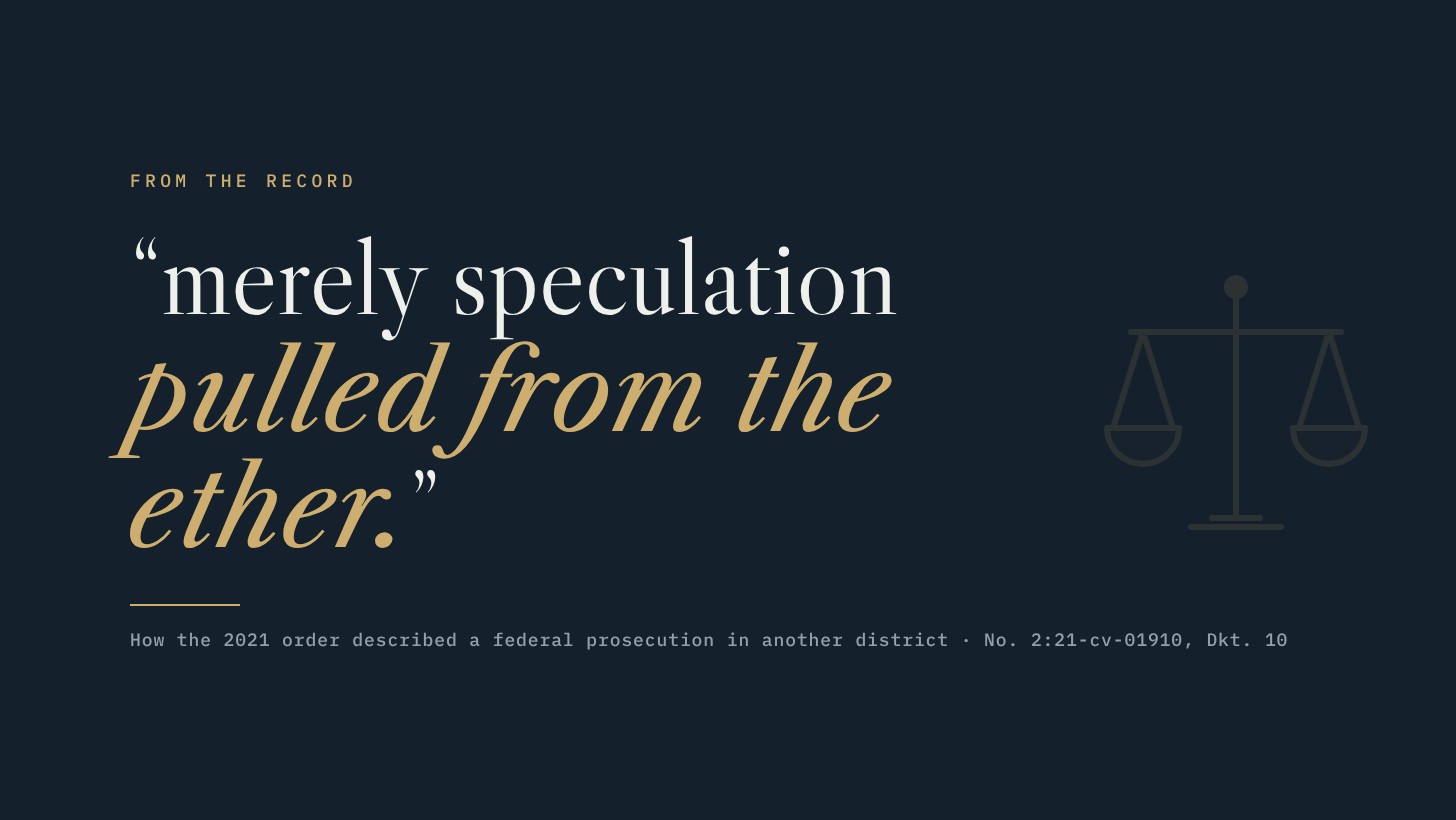
that the victims’ account was “merely speculation pulled from the ether”;
and that there was “no basis to establish any rights under the [CVRA].”
The prosecution was in Missouri. As the petition puts it, the judge had no role, no involvement, and entered no order in it.
(No. 2:21-cv-01910, Dkt. 10.)
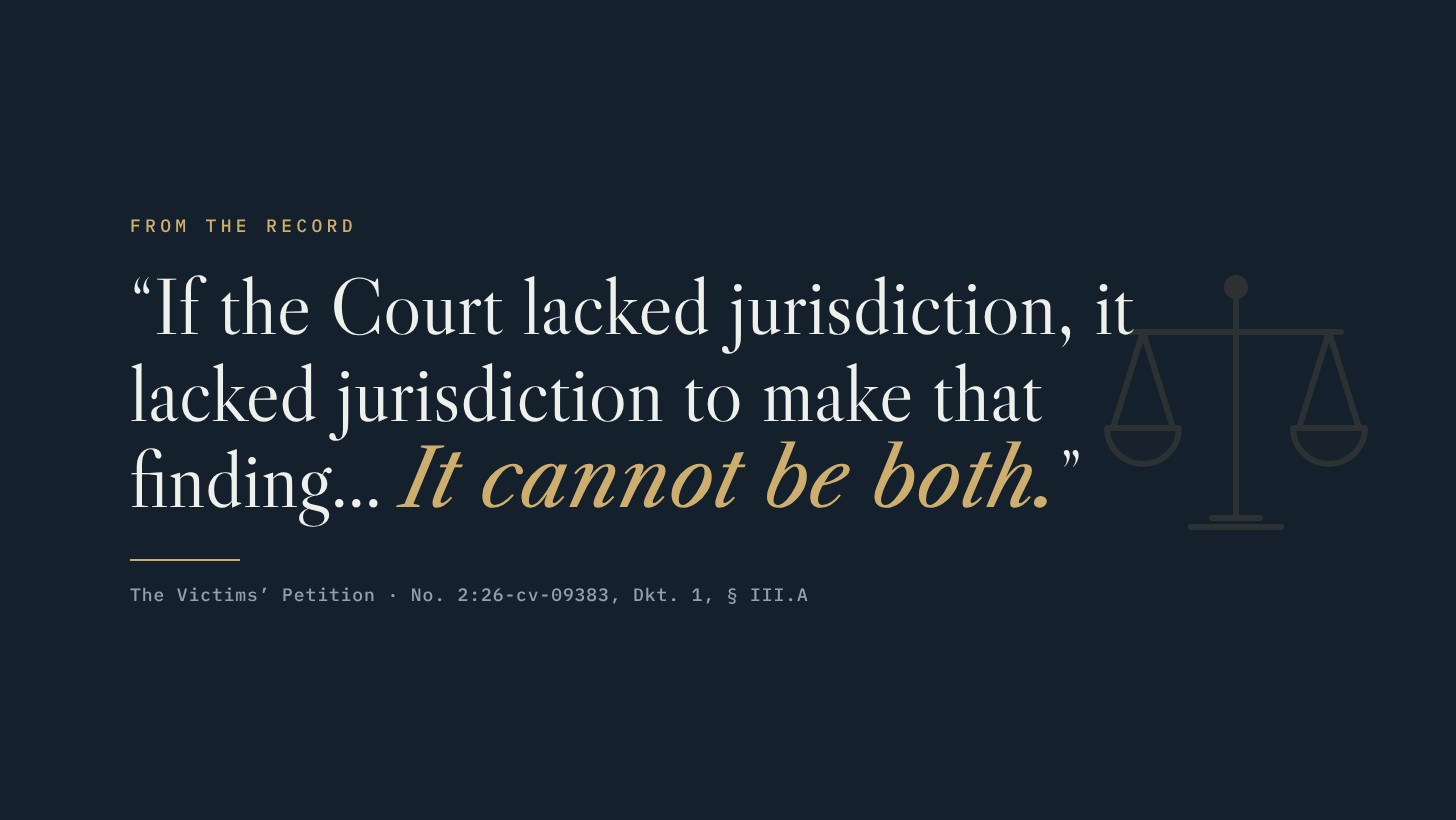
The victims’ petition put the point in four words: if the court lacked jurisdiction, it lacked jurisdiction to make that finding. “It cannot be both.”
(No. 2:26-cv-09383, Dkt. 1, § III.A.)

May 14, 2026: The victims filed a new CVRA petition, built on the Ninth Circuit’s 2025 decision in In re Davis. It was randomly assigned to a different judge.
May 22, 2026: The case was transferred to the same federal judge as “related” to his 2017 case. The transfer order bears his own signature. (No. 2:26-cv-05207, Dkt. 11.)
August 14: Four of the victims’ filings were struck on local-rule grounds, including their request for protection, and a show-cause order threatened dismissal. (Dkt. 35; Dkt. 36.)
August 18: Four refiled versions were struck again, with a warning that further noncompliance could bring sanctions. (Dkt. 43.)
The statute commands that a crime victim’s motion be decided “forthwith.” It sat for three months.

August 21, 2026: The victims filed an 88-page emergency petition under the CVRA and the Mandatory Victims Restitution Act. It named three Respondents: the United States, the Department of Justice, and the federal judge, in his official capacity only. It sought no damages and no personal relief. (No. 2:26-cv-09383, Dkt. 1.)
The judge was served through the U.S. Attorney’s Office under Rule 4(i)(2), along with the United States and the Department of Justice. (No. 2:26-cv-09383, Dkt. 15, § VII.)
August 24, 2026: The victims asked him to step aside from their other case. A judge who is a party to a proceeding is disqualified by statute, under 28 U.S.C. § 455(b)(5)(i). (No. 2:26-cv-05207, Dkt. 47.)
August 26, 10:24 a.m.: The request was entered on the docket.
August 26, 11:14 a.m.: The judge recused himself.

October 1, 2026: After another disqualification request, the same judge recused himself from the victims’ 2017 case as well.
As of this writing, the government has filed no response defending the 2016 ruling that never existed.
Fifty minutes to leave. Ten years for the victims to be heard. If you don’t believe it, read it for yourself.
The record (available on PACER):
Read the victims’ petition, as filed (PDF, 88 pages) →
No. 2:26-cv-09383 (C.D. Cal.), Dkt. 1, the Aug. 21, 2026 Petition
No. 2:26-cv-05207 (C.D. Cal.), Dkts. 11, 35, 36, 43, 47, 49
No. 2:17-cv-07748 (C.D. Cal.), Dkt. 13
No. 2:21-cv-01910 (C.D. Cal.), Dkt. 10
This article summarizes and quotes filings on the public docket. It reflects the victims’ position as self-represented petitioners. No court has made findings on these matters. Nothing here is legal advice, and nothing here waives any right under the Crime Victims’ Rights Act or the Federal Tort Claims Act.