THE COMPLAINT
On October 30, 2026, the victims mailed a verified Complaint of Judicial Misconduct concerning Judge Otis D. Wright II to the Ninth Circuit’s Office of the Circuit Executive, under 28 U.S.C. §§ 351–364. The same day they filed it on the public docket. (No. 2:17-cv-07748, Dkt. 54, Ex. A.)
By its own terms, the complaint “does not challenge the correctness of any ruling.” It describes conduct, with pin cites to the docket. (Dkt. 54 at 6.)
“ACTING AS THE GOVERNMENT’S ADVOCATE”
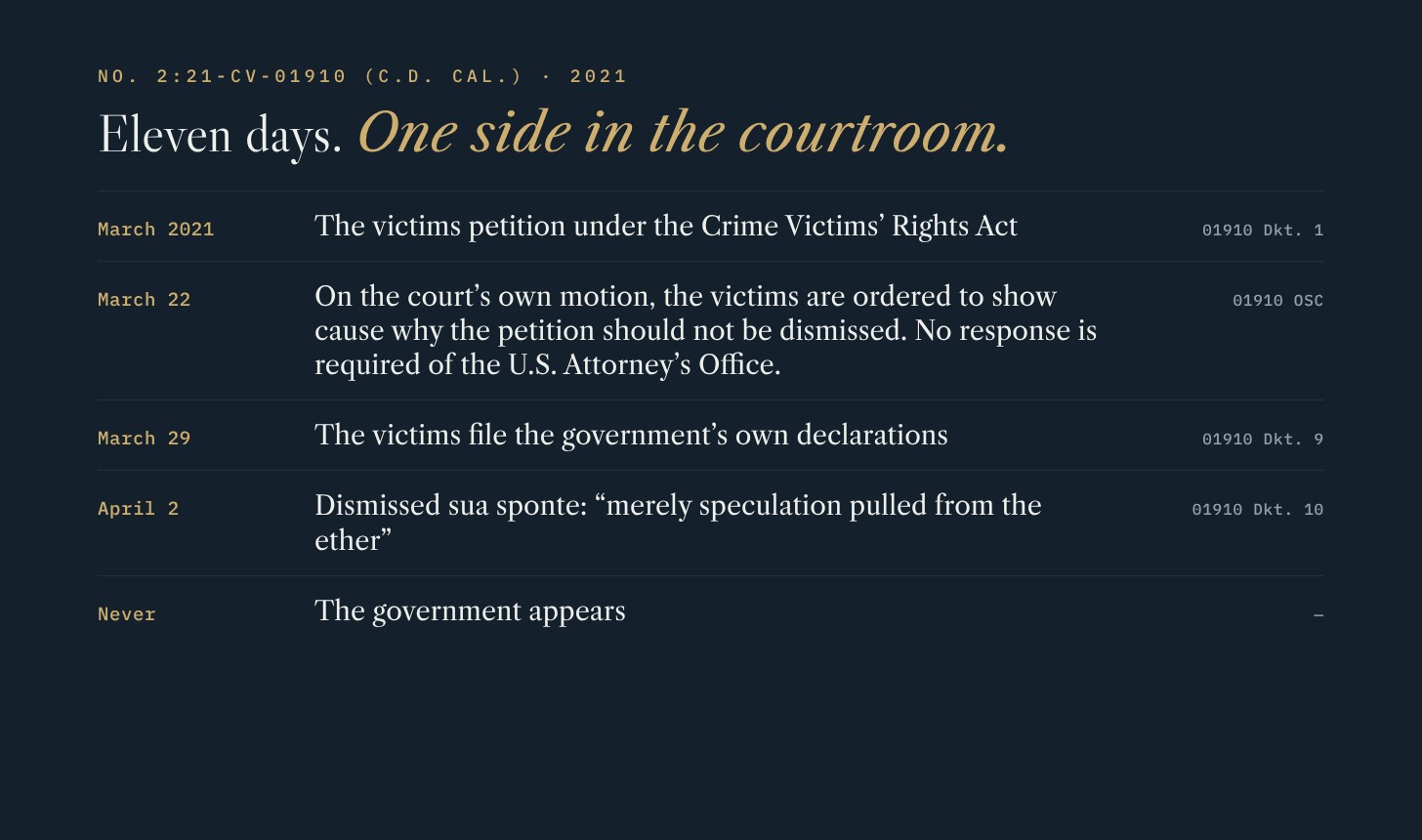
In March 2021, the victims petitioned under the Crime Victims’ Rights Act. (No. 2:21-cv-01910, Dkt. 1.)
The complaint states: “[r]equiring no response from the U.S. Attorney’s Office, he ordered the victims, on his own motion, to show cause why the petition should not be dismissed for failure to state a claim, raising a defense the government never raised.” (Dkt. 54, Ex. A, Statement of Facts at 2.)
On March 29, the victims filed the government’s own declarations. Four days later, the petition was dismissed sua sponte, on the court’s own motion. (No. 2:21-cv-01910, Dkts. 9, 10.)
The government never appeared in that case.
NO AUTHORITY, AND A RULING ANYWAY
The Act places a victim’s petition in the district where the prosecution is, or where “the crime occurred.” As the complaint puts it: “here, the Western District of Missouri.” (18 U.S.C. § 3771(d)(3); Statement of Facts at 2.)
In 2018, Judge Wright held that his court lacked subject-matter jurisdiction over every claim before it. (No. 2:17-cv-07748, Dkt. 13 at 10, 13.)
In 2021, he “reaffirm[ed]” that order as though it had decided the victims’ rights. He called their account “merely speculation pulled from the ether” and cited an “earlier determination” under the Crime Victims’ Rights Act that no court ever made. (No. 2:21-cv-01910, Dkt. 10 at 1–2.)
He cited the 2018 order under a case number that does not exist: “17-cv-07747.” (Id. at 1.)
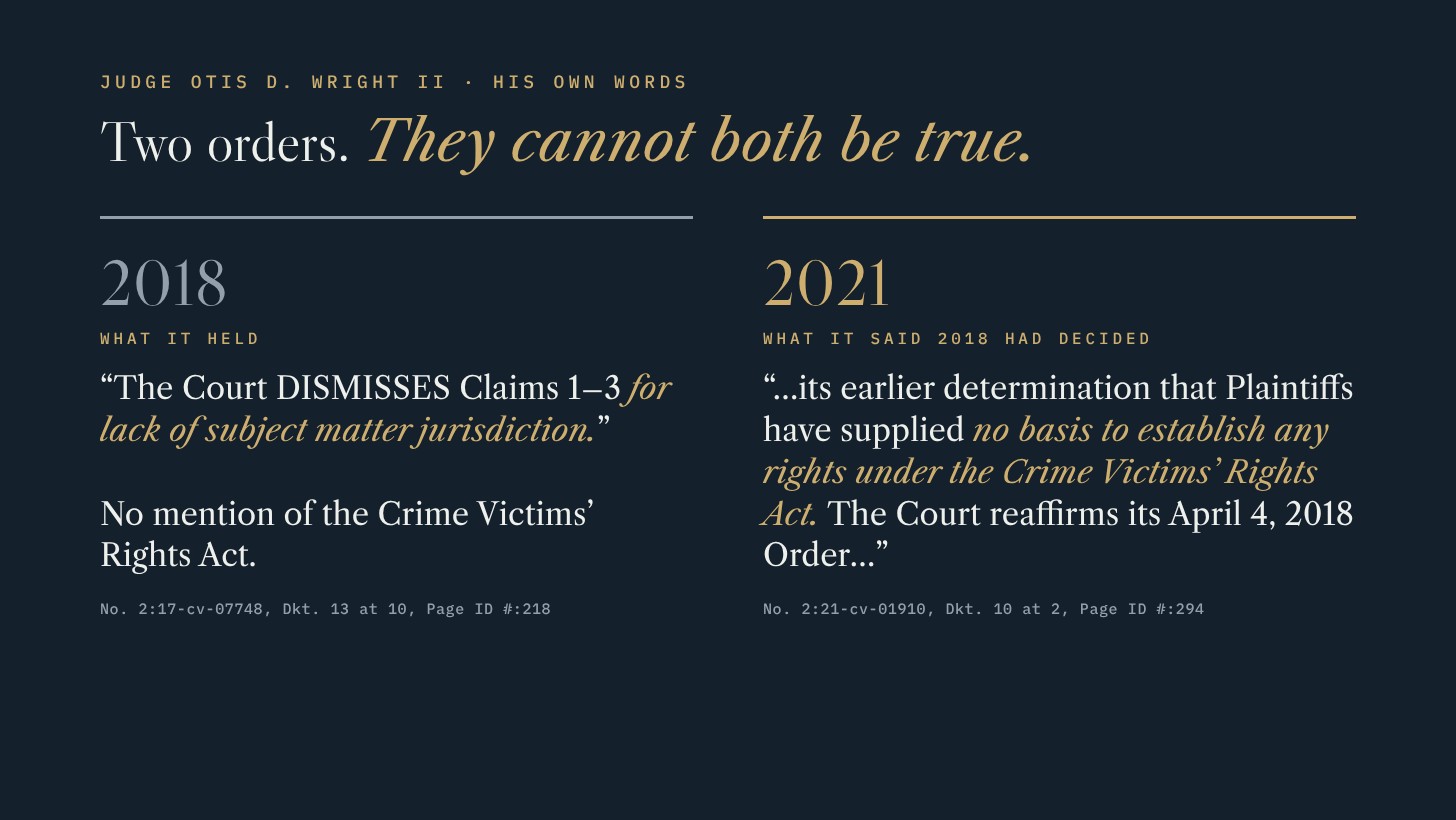
The victims’ filing puts it plainly: “Either the 2018 order decided nothing beyond jurisdiction, in which case there was no ‘earlier determination’ to reaffirm; or it decided the victims’ rights, in which case it did so without jurisdiction.” (No. 2:17-cv-07748, Dkt. 54 at 10.)
WHAT THE JUDGE HAD ALREADY WRITTEN
Three years earlier, Judge Wright’s 2018 order had recited:
the “extensive investigation for criminal trademark infringement”;
“over $26 million” recovered;
an “established victims’ fund.”
(No. 2:17-cv-07748, Dkt. 13 at 2.)
In 2021, he called the victims’ account of that same investigation “speculation pulled from the ether.”
PROOF STRUCK ON A MEET-AND-CONFER RULE
In 2021, the government answered the victims’ fraud-on-the-court motion with “assuming arguendo,” not a denial. (Dkt. 23 at 5.)
Fifteen days later, Judge Wright struck the motion for failure to meet and confer, “without a word on its substance.” Counsel had sworn that he initiated the conference and that “no one from the Office ever called or conferred with him.” (Statement of Facts at 3; Dkt. 24 at 14–15; Dkt. 25.)
The complaint cites Canon 3B(6), which requires a judge to “take appropriate action upon learning of reliable evidence indicating the likelihood” of attorney misconduct. It states: “He took no action of any kind.” (Statement of Facts at 3–4.)
A CASE ABOUT HIS OWN ORDERS
In 2026, the victims filed a new petition challenging Judge Wright’s own orders, and it was transferred to him. He kept it three months. In that time he:
struck both requests to decide it “forthwith”;
struck the request for protection;
threatened dismissal.
According to the complaint, he never required the U.S. Attorney’s Office “to appear or respond.” (Statement of Facts at 4; No. 2:26-cv-05207, Dkts. 11, 35, 36, 43.)
Only after the victims named him a Respondent did he recuse, “fifty minutes after a disqualification application was entered.” (Statement of Facts at 4; No. 2:26-cv-05207, Dkts. 47, 49.)
The complaint quotes the Supreme Court: “[N]o man can be a judge in his own case.” (In re Murchison, 349 U.S. 133, 136 (1955).)
WHAT THE COMPLAINT ASKS
It asks the Chief Judge of the Ninth Circuit to conduct a limited inquiry under Rule 11(b) and, if warranted, to appoint a special committee under 28 U.S.C. § 353. (Statement of Facts at 5.)
The complaint form discloses that the 2021 dismissal was affirmed on appeal (9th Cir. No. 21-55417, Mar. 24, 2022). The complaint concerns conduct, not whether that ruling was correct.
Whether misconduct occurred is for the Chief Judge and the Judicial Council of the Ninth Circuit to decide.
THE COMPLAINT, AS FILED
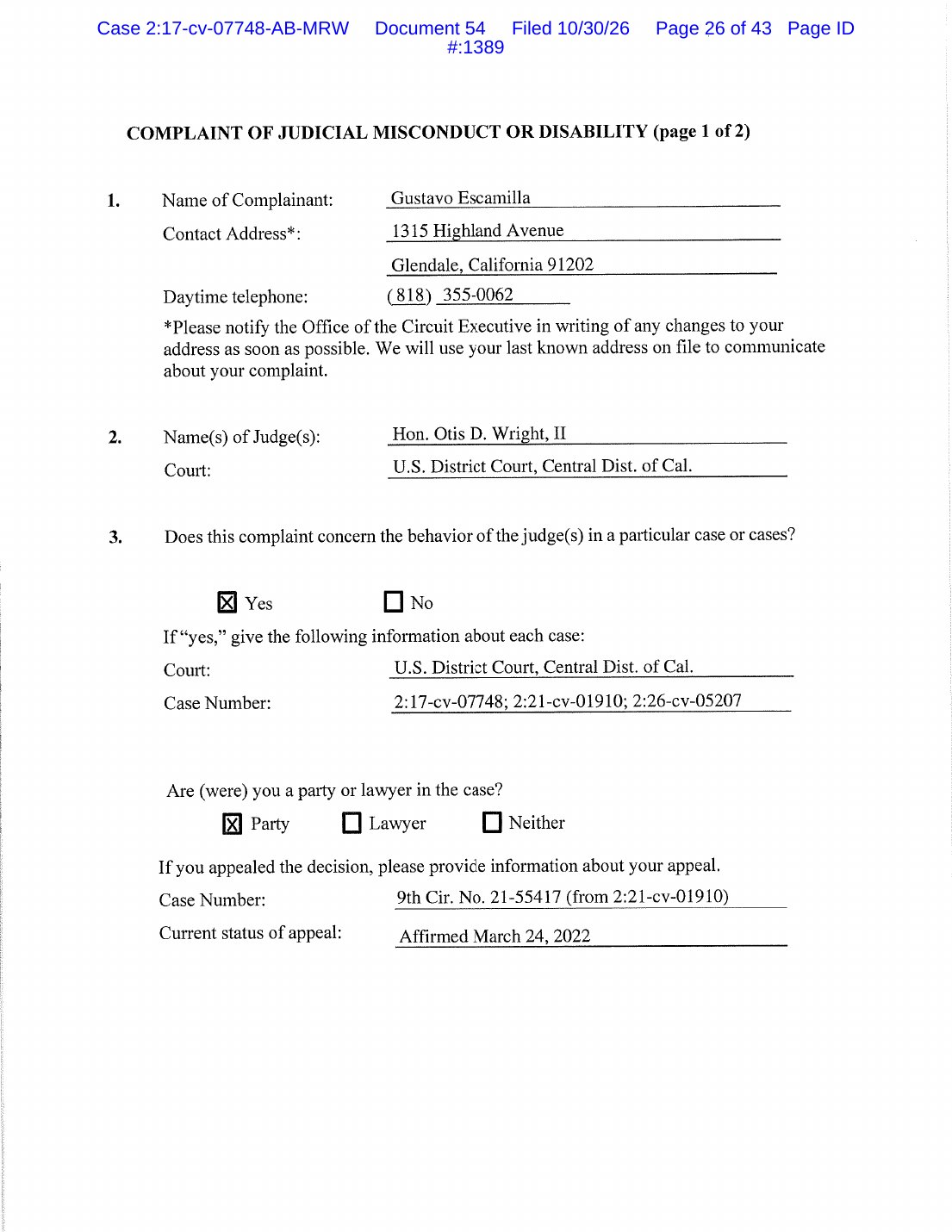
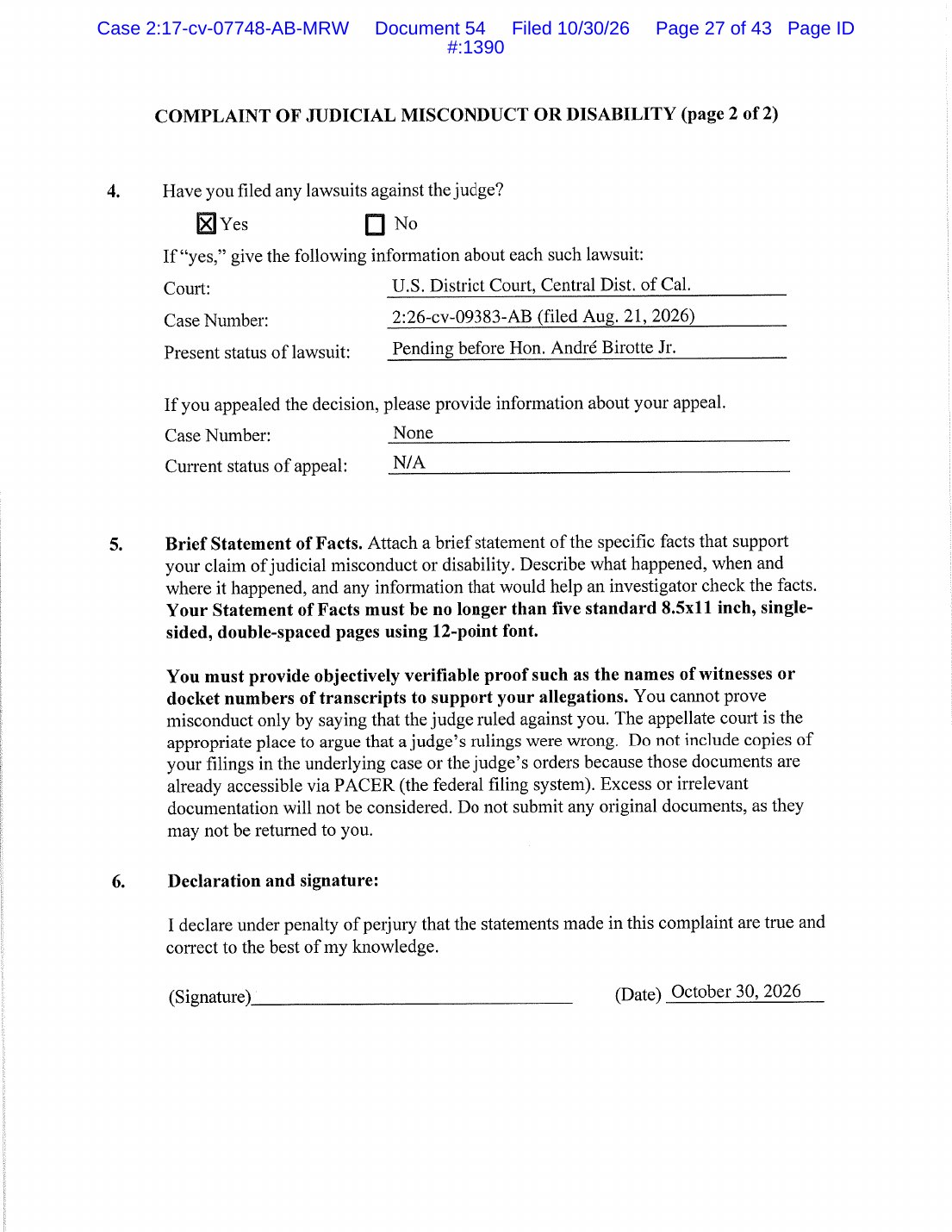
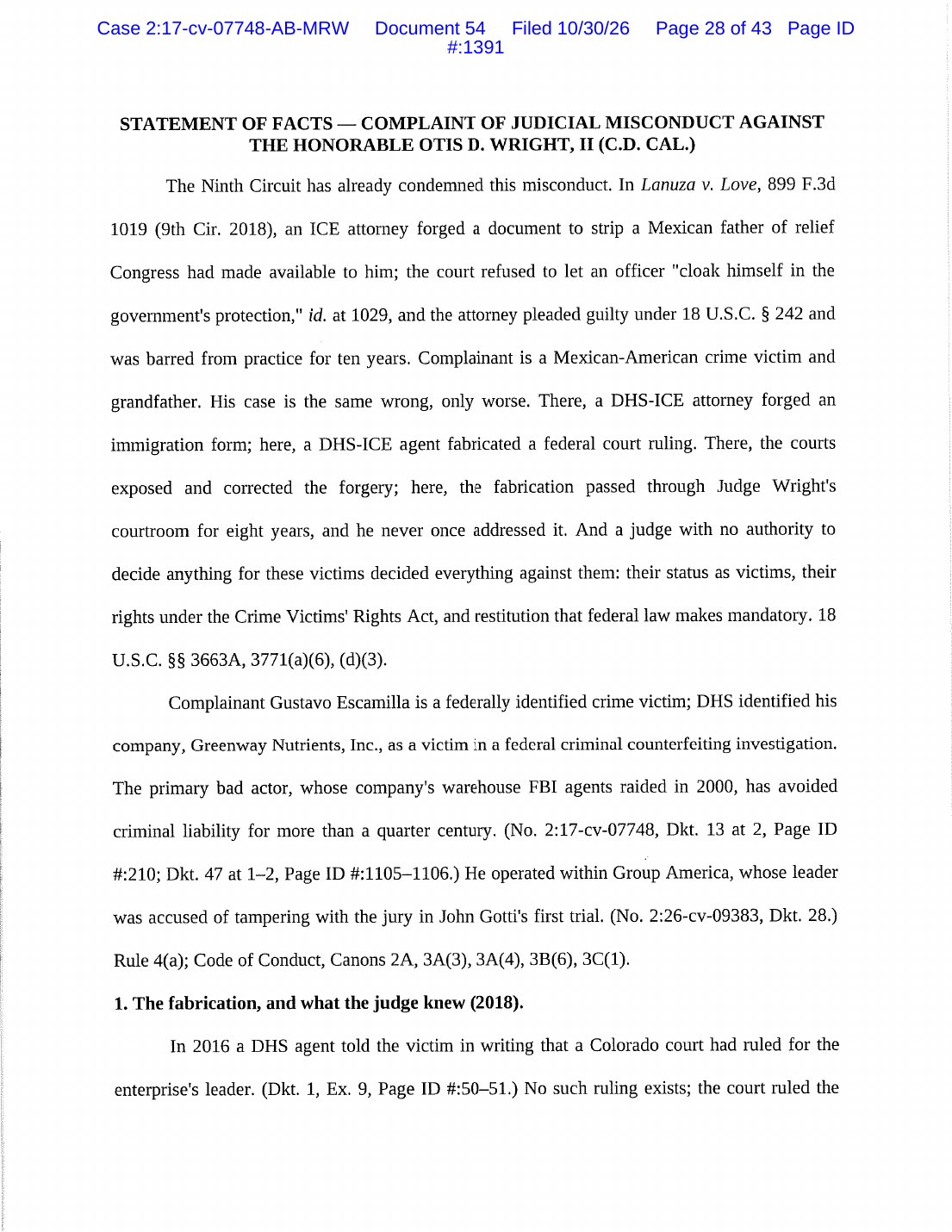
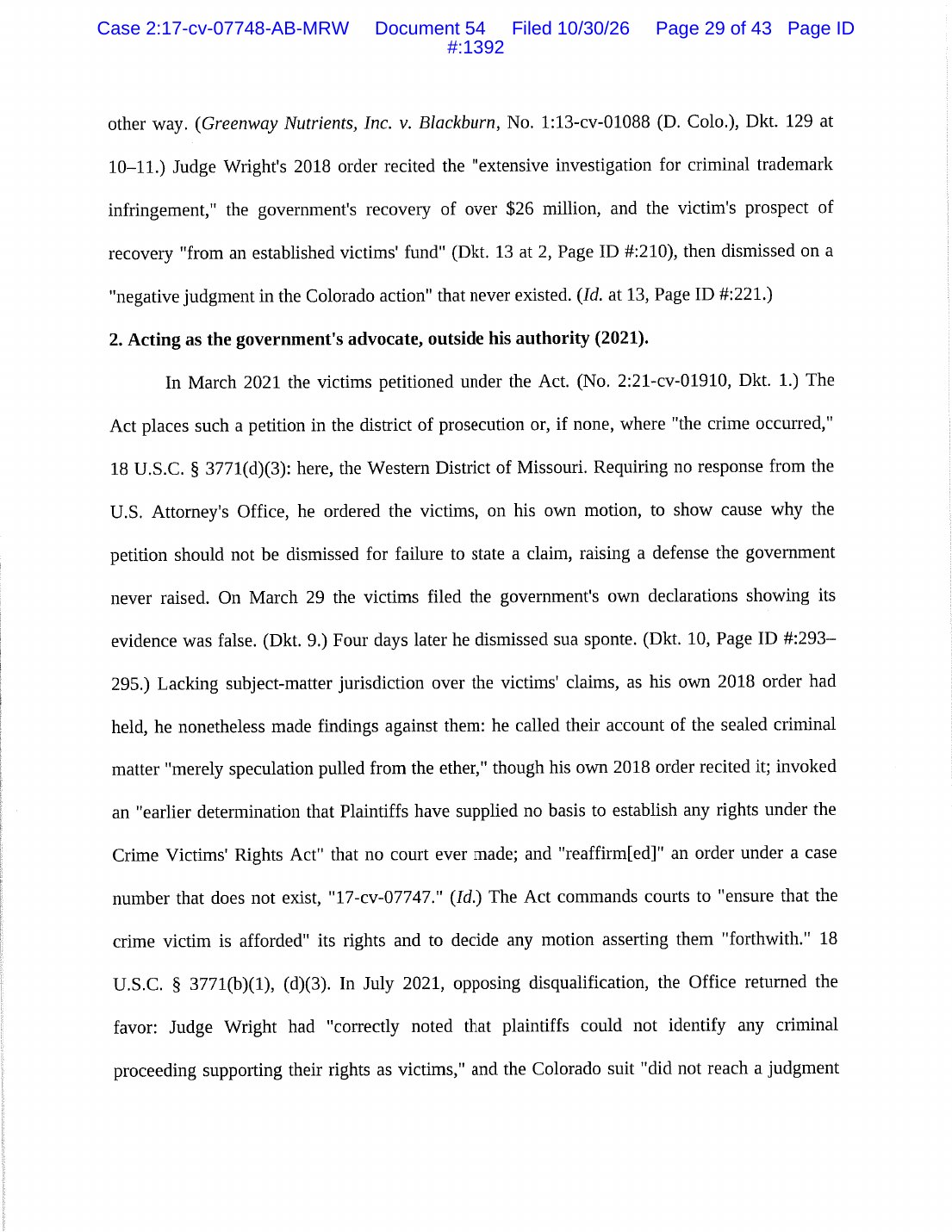
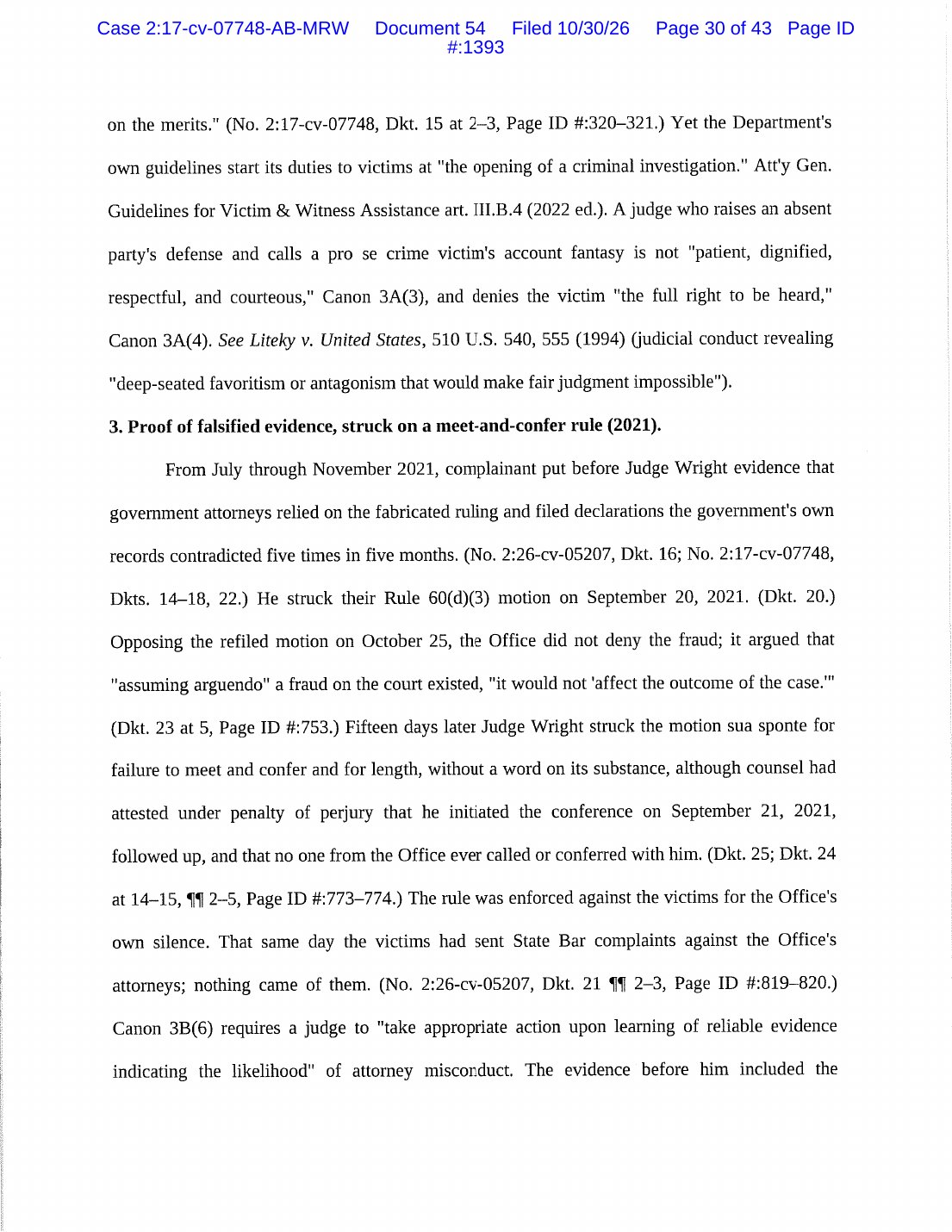
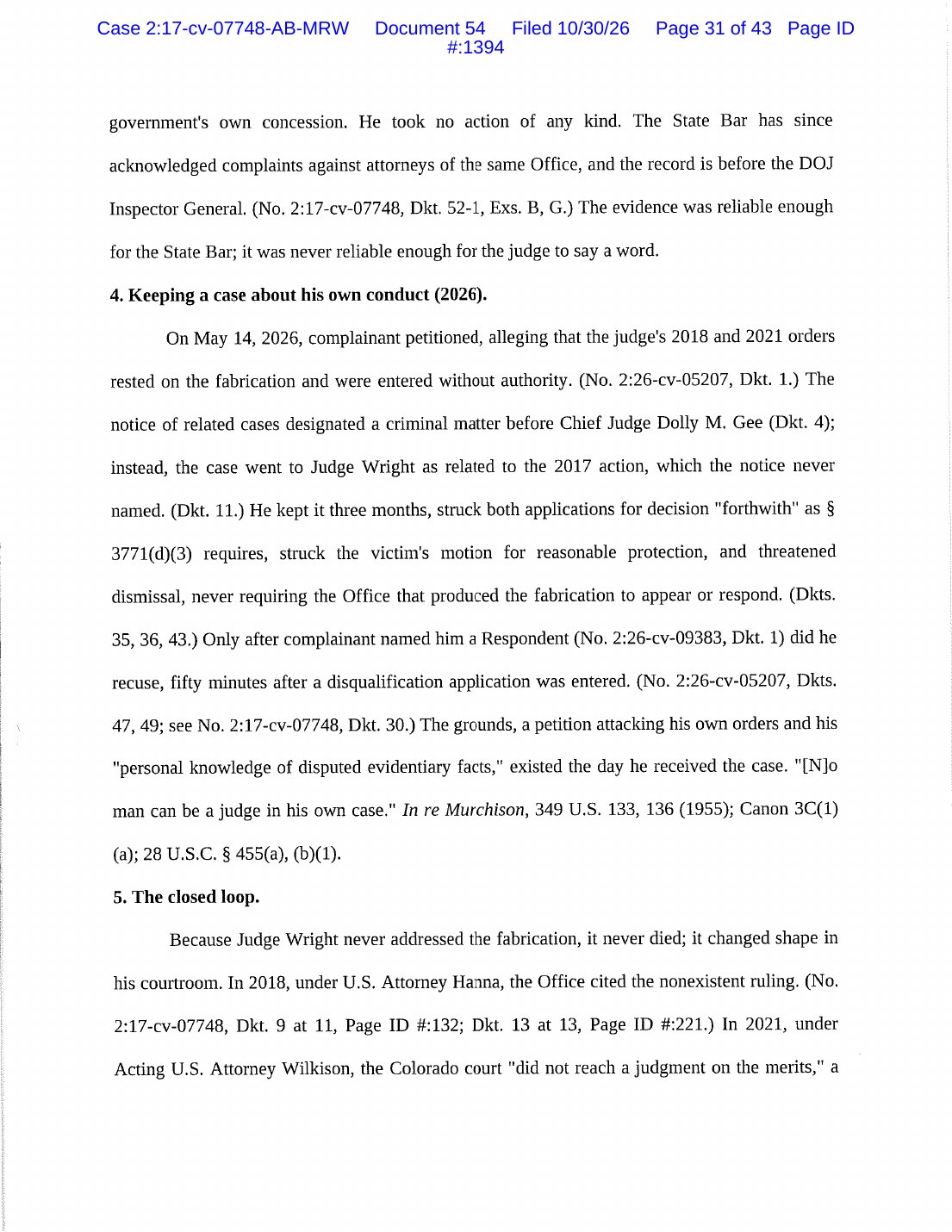
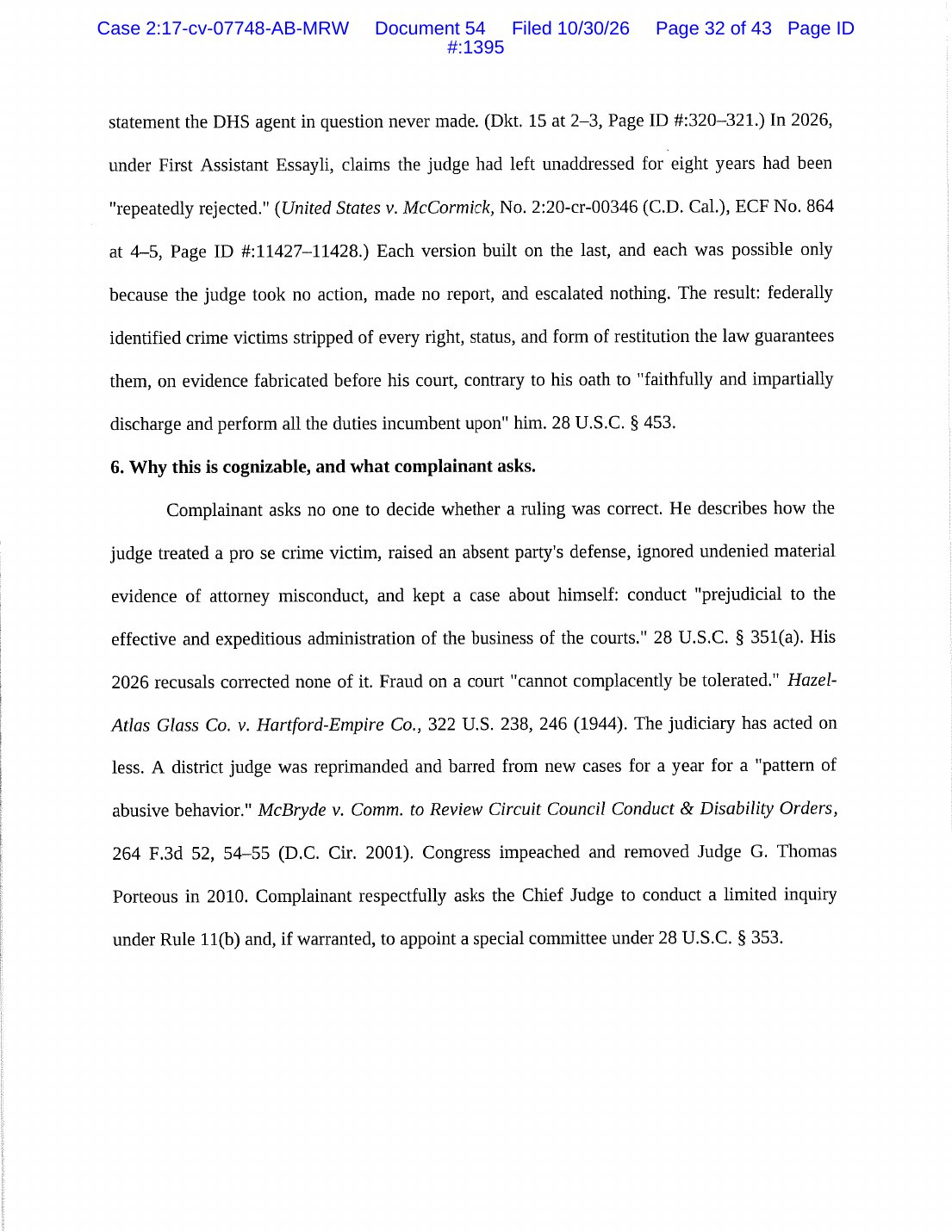
The pages above are reproduced exactly as filed in federal court. They state the victims’ allegations. No court or judicial council has made findings on them.
The government never appeared. The judge raised its defense for it. If you don’t believe it, read it for yourself.
The record (available on PACER):
No. 2:17-cv-07748 (C.D. Cal.), Dkts. 13, 23, 24, 25, 54
No. 2:21-cv-01910 (C.D. Cal.), Dkts. 1, 9, 10
No. 2:26-cv-05207 (C.D. Cal.), Dkts. 11, 35, 36, 43, 47, 49
No. 2:26-cv-09383 (C.D. Cal.), Dkt. 1
This article summarizes and quotes filings on the public docket, including a complaint reproduced as filed. It reflects the victims’ position as self-represented petitioners. No court or judicial council has made findings on these matters. Nothing here is legal advice, and nothing here waives any right under the Crime Victims’ Rights Act or the Federal Tort Claims Act.