THE SILENCE
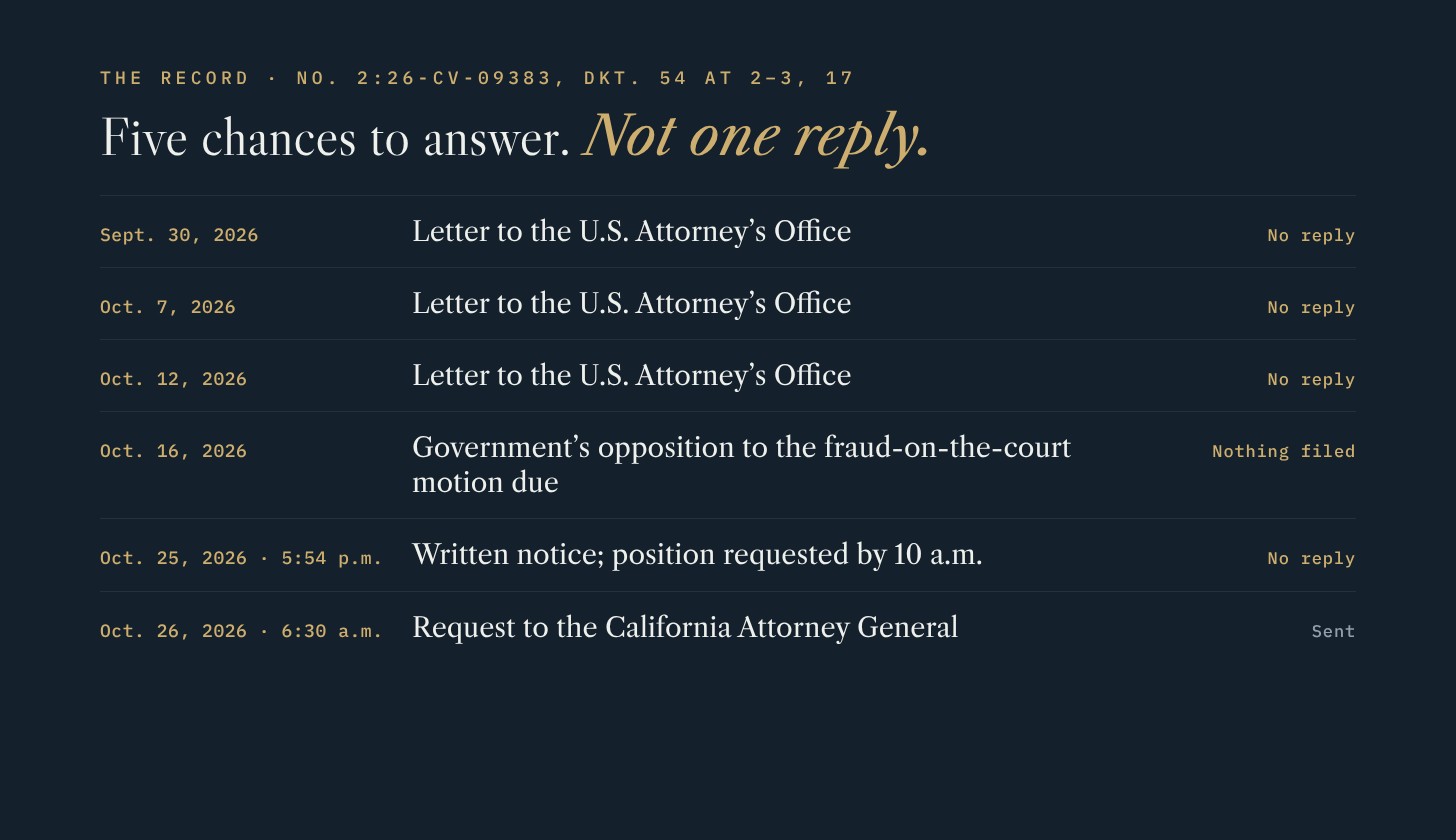
The victims wrote to the U.S. Attorney’s Office on September 30, October 7 and October 12, 2026. None of those letters was answered. (No. 2:26-cv-09383, Dkt. 54 at 3.)
The government’s opposition to the victims’ fraud-on-the-court motion was due October 16. “None was filed, and none has been filed since.” (Id. at 2.)
At 5:54 p.m. on October 25, the victims gave the Office written notice of this filing and asked for its position by 10 a.m. the next morning. They wrote that they would “note your office’s position, or its silence.” (Id. at 2–3; Ex. A.) No answer came.
THE REQUEST TO CALIFORNIA
At 6:30 a.m. on October 26, the victims sent a written request to Attorney General Rob Bonta’s office. (Dkt. 54 at 3.)
It reads in part:
“A federal agency (DHS-ICE) named a Mexican-American grandfather a crime victim. It promised him restitution, a victims’ fund, and a place in the government’s case. Then one of its own agents invented a court ruling to take all of it away… It changed its story three times. It never once denied the misconduct. And when he finally asked the court to set the fabricated judgment aside, the Office did not show up.” (Id. at 5.)
It invokes Marsy’s Law, California Constitution article I, section 28. Under it, every crime victim has the right “[t]o be treated with fairness and respect for his or her privacy and dignity,” and to “seek and secure restitution.” (Id. at 6–7.)
It asks the Attorney General’s office to:
refer the matter to its Civil Rights Enforcement Section;
honor the victim’s rights in any state proceeding;
consider supporting crime-victim enforcement as amicus curiae;
say in writing which of these steps it will take. (Id. at 6.)
WHAT THE VICTIM’S OWN LAWYER WROTE
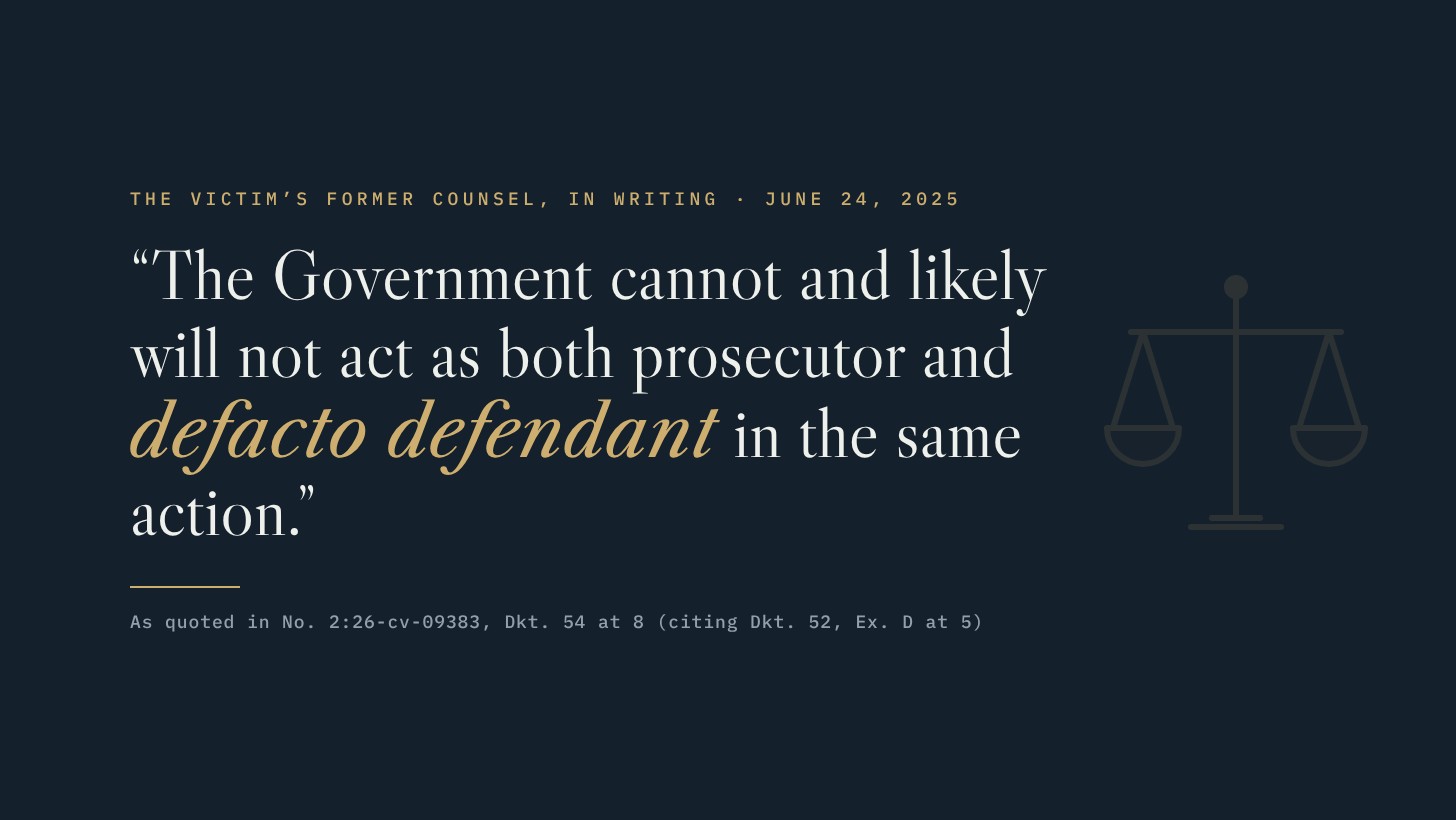
The victims’ former counsel, Allison B. Margolin, held their crime-victim petition for thirteen months and did not file it. She withdrew in a written memorandum dated June 24, 2025, which is on the court record. (Dkt. 54 at 7; Dkt. 52, Ex. D.)
In that memorandum, she wrote:
that the DHS agent “improperly advised Mr. Escamilla that the 2013 case contained a ruling in favor of Selakovic”;
that the 2017 case was dismissed “[r]elying on allegedly false and misleading filings by the U.S. Attorney’s Office”;
that raising the issue “could also force the Court to appoint Special Counsel due to a conflict of interest within the U.S. Attorney’s Office.”
(Dkt. 52, Ex. D at 2, 5, as quoted in Dkt. 54 at 7–8.)
She withdrew from the victims’ matter but continued representing a family member in a federal prosecution brought by the same Office. (Dkt. 54 at 8.)
On October 26, the victims filed a verified complaint against her with the State Bar of California. The filing states that the complaint “contends” violations of several Rules of Professional Conduct. (Id. at 11–12; Decl. ¶ 4.)
In the filing’s words: “Petitioner asks this Court to find nothing about Ms. Margolin. Those questions are for the State Bar.” (Id. at 12.)
“REPEATEDLY REJECTED”
In another filing, the Office described the victims’ claims as “broad allegations of government misconduct that courts have repeatedly rejected.” (Dkt. 54 at 13.)
In the same paragraph, it conceded that “the government does not address them here in substance.” (Id. at 9.)
The victims’ response: “No court has reached them on the merits. The Office has never denied them.” (Id. at 9.)
Four letters. One missed deadline. No reply. If you don’t believe it, read it for yourself.
The record (available on PACER):
No. 2:26-cv-09383 (C.D. Cal.), Dkts. 8, 52, 54
No. 2:17-cv-07748 (C.D. Cal.), Dkts. 23, 47
This article summarizes and quotes filings on the public docket. It reflects the victims’ position as self-represented petitioners. No court, bar or agency has made findings on these matters. Nothing here is legal advice, and nothing here waives any right under the Crime Victims’ Rights Act, the Federal Tort Claims Act, or article I, section 28 of the California Constitution.