On September 30, 2026, a crime victim representing himself filed a motion in federal court in Los Angeles. It asked the court to set aside a judgment entered against him on April 4, 2018, on the ground that it was procured by a fraud on the court: a court ruling that, according to the motion, no court ever made.
The U.S. Attorney’s Office for the Central District of California represents the government in that case. The Victim’s filings show what it did next.
Three notices before a single page was filed
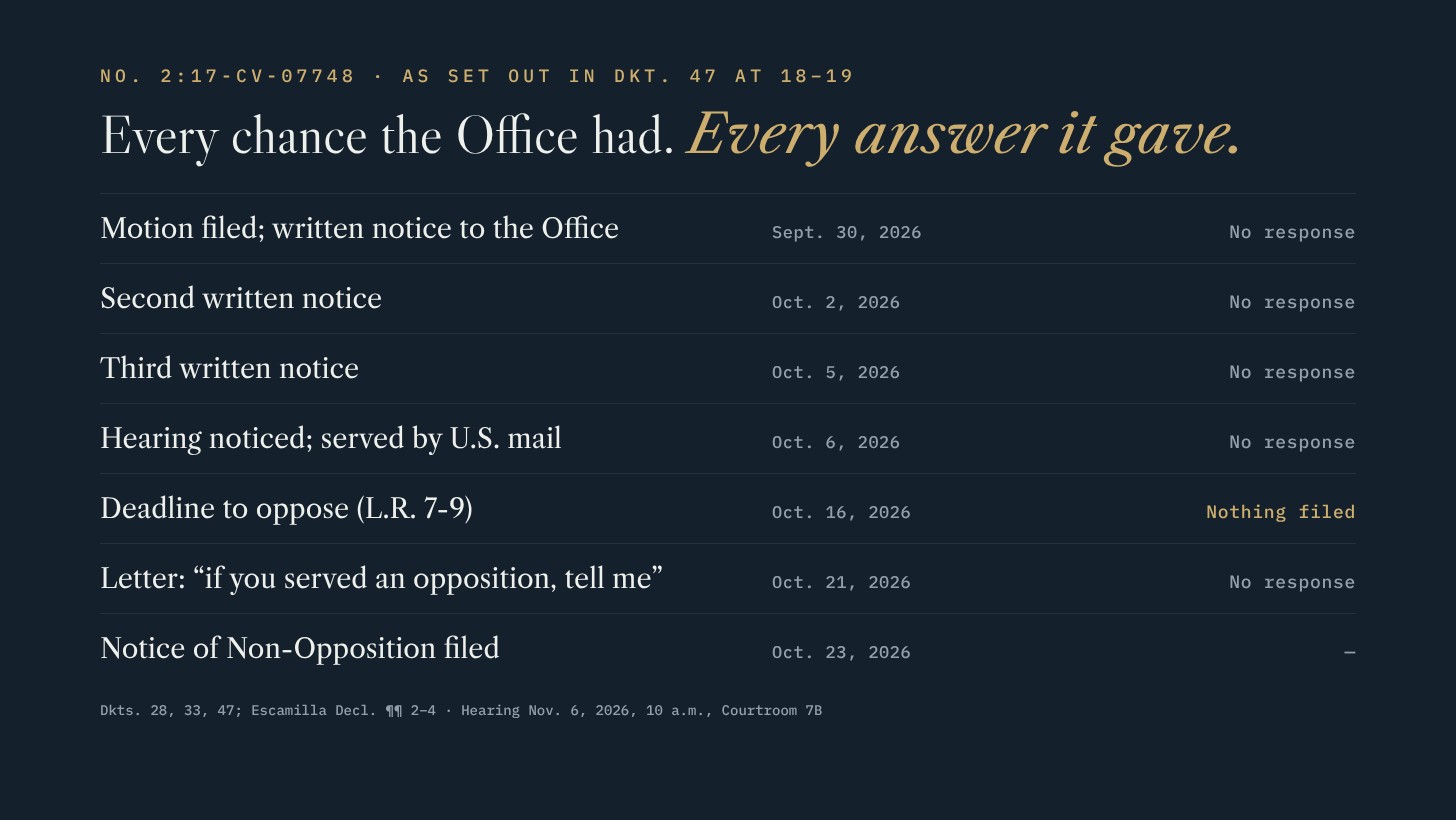
Before the motion was filed, the Victim gave the Office written notice, as the court’s local rules require, on September 30, October 2 and October 5, 2026. The rule exists so the parties can talk before the court is asked to decide anything. The Office did not respond to any of the three. (Dkt. 33.)
On October 6, he noticed the motion for hearing on November 6, 2026, at 10:00 a.m., before U.S. District Judge André Birotte Jr., and served the notice of hearing and a proposed order on the U.S. Attorney’s Office and the Attorney General of the United States by mail. (Dkt. 33.)
The deadline
Under Local Rule 7-9, any opposition was due 21 days before the hearing: October 16, 2026. That was 16 days after the motion was filed.
October 16 came and went. The docket shows no opposition, no statement of non-opposition and no request for more time. Nothing was served on the Victim by mail or email. (Dkt. 47 at 18.)
One last chance
On October 21, five days past the deadline, the Victim wrote to the Assistant U.S. Attorney and the Acting Civil Chief responsible for the case. He told them no opposition had been filed and that he intended to ask the court to treat the motion as unopposed. If the Office had served an opposition he hadn’t received, he asked them to tell him right away.
The Office did not respond. (Dkt. 47 at 18–19.)
Two days later, on October 23, he filed an Emergency Notice of Non-Opposition. (Dkt. 47.)
What the rule says
The court’s Local Rule 7-12 is short:
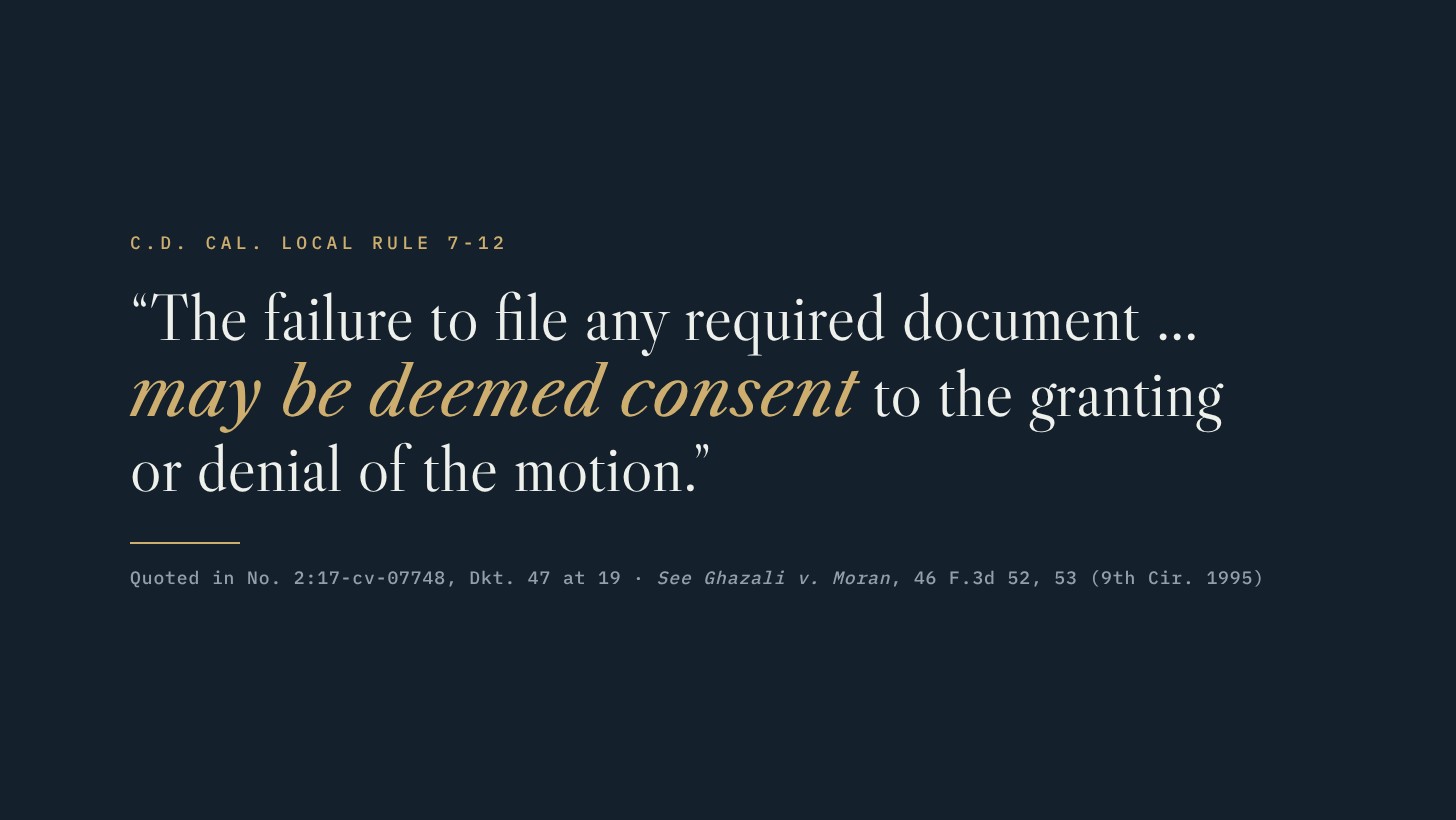
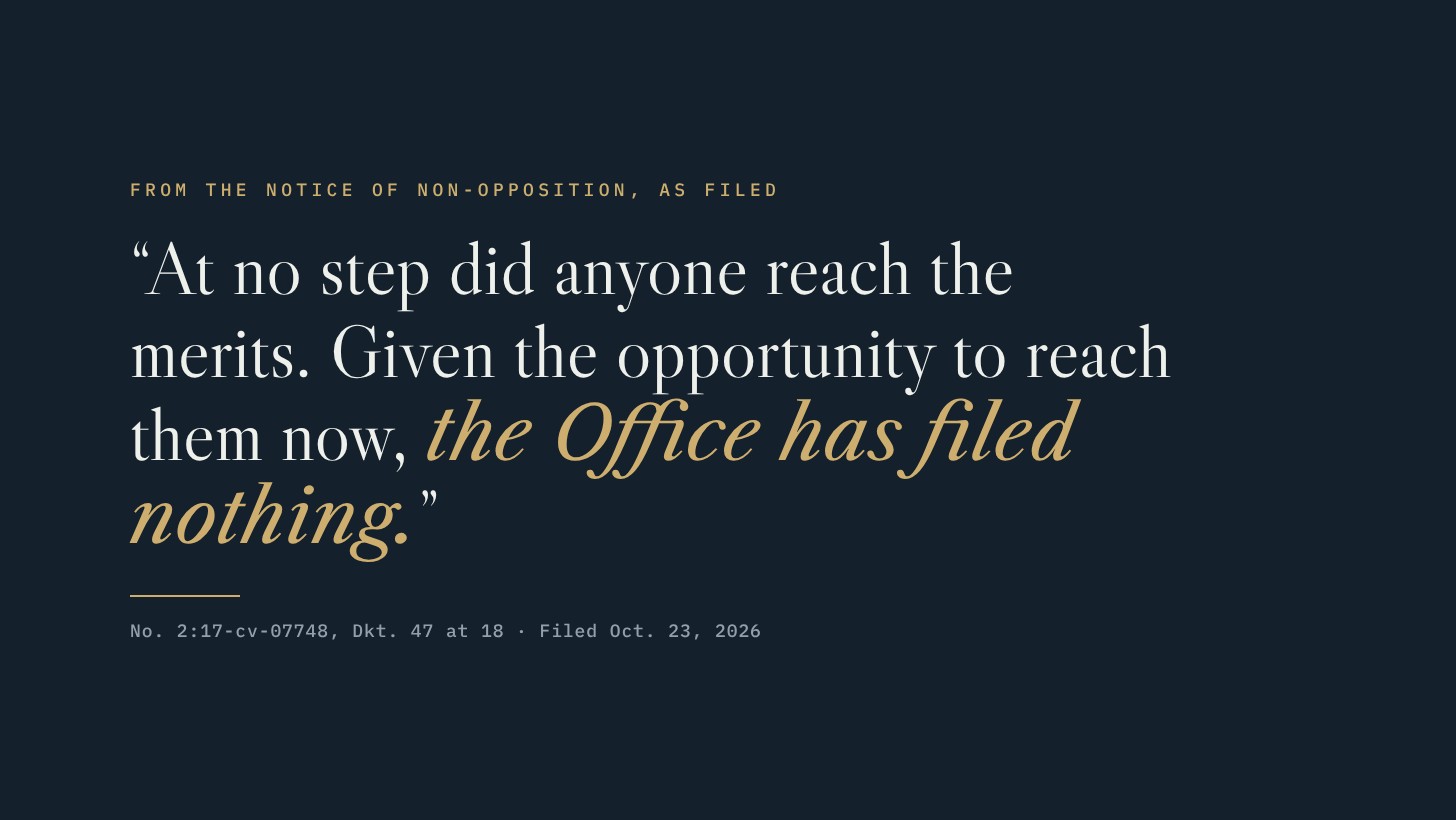
The Ninth Circuit has upheld granting a motion on exactly that basis. Ghazali v. Moran, 46 F.3d 52, 53 (9th Cir. 1995). As the Notice puts it, the Office “is represented by counsel, received the Motion and the Notice of Hearing, and was told in writing, before this Notice was filed, that its opposition was overdue. It chose not to respond.” (Dkt. 47 at 19.)
Not the first time it didn’t deny it
This isn’t the Office’s first chance to address the fraud. In 2021, when the Victim first challenged the same judgment, the Office did not deny the fraud. It argued that, “assuming arguendo” a fraud on the court existed, it would not affect the outcome. (Dkt. 23 at 5.)
In 2026, it has not answered at all. As the Notice states, the motion’s showing that the April 4, 2018 judgment was procured by a court ruling no court ever made, carried into the court by officers of the court, “stands unrebutted.” (Dkt. 47 at 19.)
What he is asking for
The Victim asks the court to treat the Office’s silence as consent, grant the motion, set aside the 2018 judgment and enter findings that:
no court ever made the ruling the government relied on;
that purported ruling originated with a DHS agent in the course of a criminal investigation, outside any judicial proceeding;
the U.S. Attorney’s Office presented it to the court and has never denied it; and
the fabrication, and the judgment it produced, deprived him of due process under the Fifth Amendment.
In the alternative, he asks the court to order the government to answer each misrepresentation on the merits, under oath, and to set an evidentiary hearing. (Dkt. 47 at 19–20.)
Friday, 10 a.m.
The hearing is Friday, November 6, 2026, at 10:00 a.m., Courtroom 7B, First Street U.S. Courthouse, 350 W. 1st Street, Los Angeles. It is open to the public.
Two weeks later, on November 20, the court will hear the Victim’s motion to disqualify the entire U.S. Attorney’s Office for the Central District of California from his cases.
The record speaks for itself. Read it at gustavoescamilla.com/record.
This post describes filings on the public record in the U.S. District Court for the Central District of California, No. 2:17-cv-07748. Characterizations of conduct reflect positions stated in those filings. No court has made findings on the matters described. Nothing here alleges a crime by any person.