Fraud on the court “is a wrong against the institutions set up to protect and safeguard the public.” — Hazel-Atlas Glass Co. v. Hartford-Empire Co., 322 U.S. 238, 246 (1944)
THE SHORT VERSION
- Federal judges are immune from being sued for their rulings. They are not immune from their duties. Congress wrote that “the court shall ensure that the crime victim is afforded” every right in the Crime Victims’ Rights Act. 18 U.S.C. § 3771(b)(1).
- When a judge falls short, a victim has lawful remedies. He can file a motion in the district court, petition the court of appeals for a writ of mandamus, move to disqualify the judge, and file a complaint of judicial misconduct.
- One crime victim has now filed two such complaints with the Ninth Circuit. The first concerns the Honorable Otis D. Wright II and was docketed as No. 26-90261. The second, mailed today, concerns the Honorable André Birotte Jr.
- Neither complaint has been decided. Both rest on the court record, and that record is quoted below with page cites.
- Here is how any victim can do the same, and how to carry yourself while you do it.
A word before we begin
This is not an article about anger. It is about a grandfather who spent more than a decade learning the law the hard way, because the people whose job was to explain it to him did not.
It is written for every crime victim who has stood in a federal courthouse and felt invisible. You are not invisible. You have rights, written into federal law by name, and you are allowed to ask for them.
Immunity is a shield, not a pardon
Many victims are told, in one form or another, “You can’t do anything about a judge.” That is not true. Here is what is true.
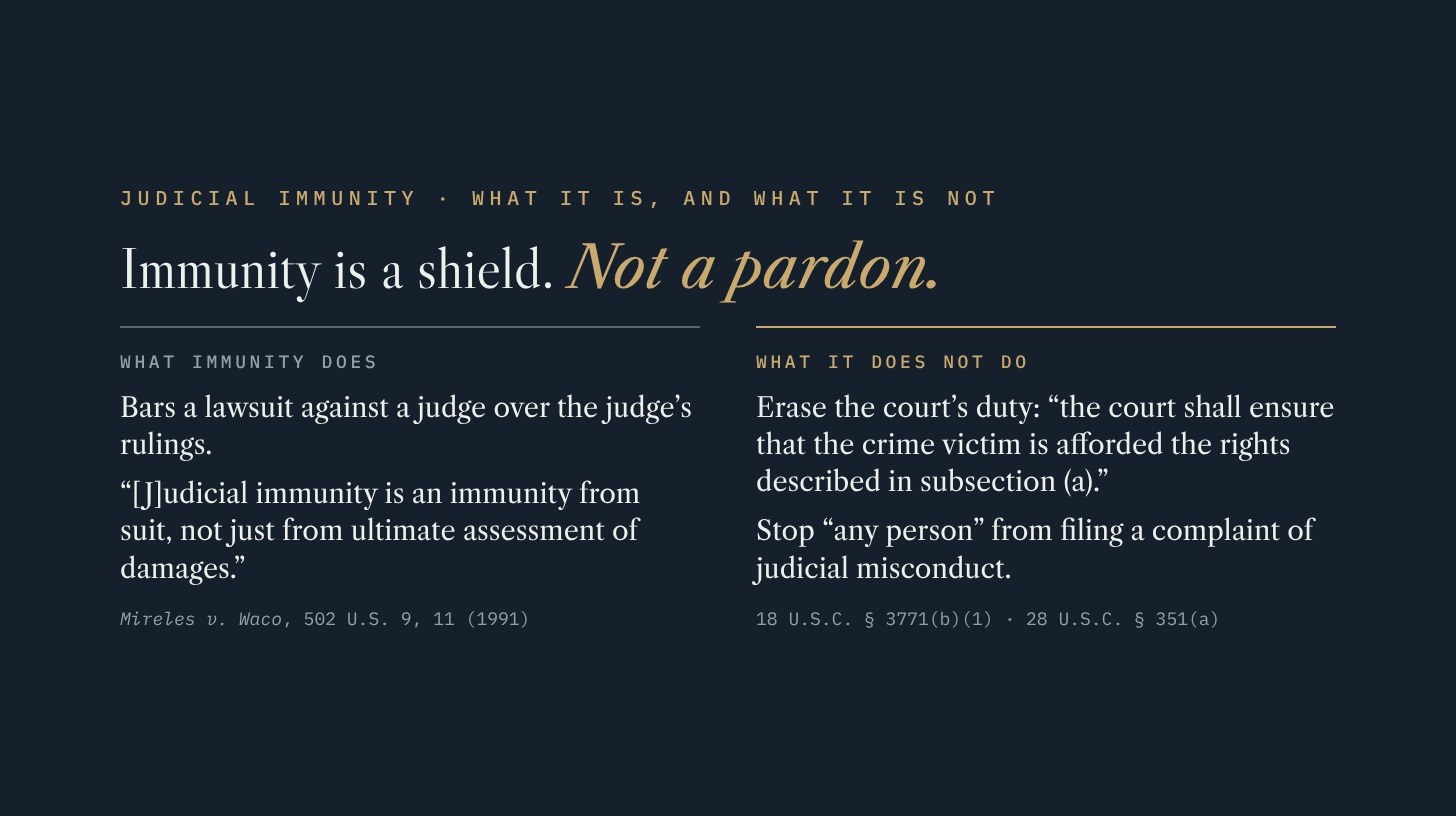
The Supreme Court has held that “judicial immunity is an immunity from suit, not just from ultimate assessment of damages,” and that it “is not overcome by allegations of bad faith or malice.” Mireles v. Waco, 502 U.S. 9, 11 (1991). In plain terms, a victim generally cannot sue a federal judge over the way the judge decided a case.
But immunity from suit is not freedom from duty. Immunity protects a judge from a lawsuit. It does not remove a single word from the statutes and codes that govern how the judge must do the job:
- The Crime Victims’ Rights Act binds the court itself. “In any court proceeding involving an offense against a crime victim, the court shall ensure that the crime victim is afforded the rights described in subsection (a).” 18 U.S.C. § 3771(b)(1). And “[t]he district court shall take up and decide any motion asserting a victim’s right forthwith.” Id. § 3771(d)(3).
- The Code of Conduct for United States Judges binds the judge personally. A judge “should take appropriate action upon receipt of reliable information indicating the likelihood . . . that a lawyer violated applicable rules of professional conduct.” Canon 3B(6). A judge should give every person with a legal interest in a proceeding “the full right to be heard according to law.” Canon 3A(4).
- Congress gave the public a way to report a judge. “Any person” may file a written complaint alleging that a judge “has engaged in conduct prejudicial to the effective and expeditious administration of the business of the courts.” 28 U.S.C. § 351(a).
Immunity shields a judge from your lawsuit. It does not shield a judge from the law, from the Code, or from review by the Circuit.
The rights you hold, by name
The Crime Victims’ Rights Act, 18 U.S.C. § 3771(a), lists ten rights. The ones most often at stake when a court fails a victim are these:
- (a)(1) The right to be reasonably protected from the accused.
- (a)(2) The right to reasonable, accurate, and timely notice.
- (a)(4) The right to be reasonably heard.
- (a)(5) The reasonable right to confer with the attorney for the Government.
- (a)(6) “The right to full and timely restitution as provided in law.” For an offense committed by fraud or deceit, restitution is mandatory. 18 U.S.C. § 3663A(c)(1)(A)(ii).
- (a)(8) “The right to be treated with fairness and with respect for the victim’s dignity and privacy.”
The Ninth Circuit has called crime victims “independent participants” in the proceedings. Kenna v. U.S. Dist. Court, 435 F.3d 1011, 1013 (9th Cir. 2006). And in 2025 it held that a victim’s petition to amend restitution under 18 U.S.C. § 3664(d)(5) is a motion asserting a victim’s right that the district court must decide forthwith. In re Davis, Nos. 24-3090 & 24-3092, 146 F.4th 710 (9th Cir. 2025) (as amended Aug. 1, 2025).
One victim’s record
Gustavo Escamilla is the President of Greenway Nutrients, Inc. In 2015 the Department of Homeland Security identified Greenway as a victim in a federal criminal counterfeiting investigation. A 2018 federal court order recited that the targets had been “subject to extensive investigation for criminal trademark infringement,” that more than $26 million had been recovered, and that Greenway “may be able to recover from an established victims’ fund.” (No. 2:17-cv-07748, Dkt. 13 at 2–3, Page ID #:210–211.)
Greenway has never received restitution. The record shows why. In 2016 a DHS agent told the victim in writing that a Colorado federal court had ruled against Greenway. No Colorado court ever made that ruling. The court had written the opposite: “The Court disagrees.” (Dkt. 1, Ex. 9, Page ID #:50; Greenway Nutrients, Inc. v. Blackburn, No. 1:13-cv-01088 (D. Colo.), Dkt. 129 at 10–11.) The case against the victim was built on that ruling, and it has been carried forward ever since.
The complaint concerning the Honorable Otis D. Wright II
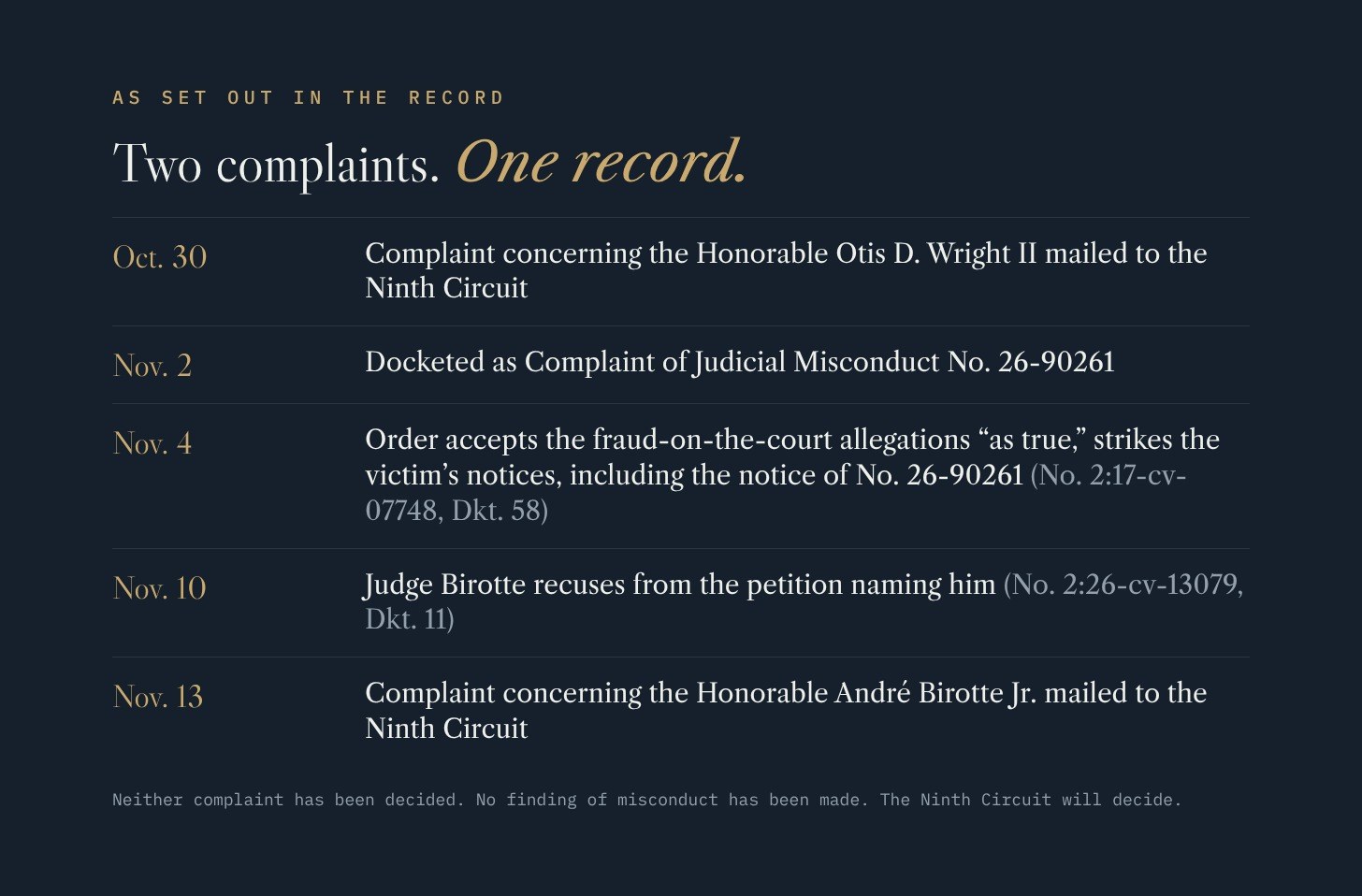
On October 30, 2026, the victim mailed a complaint of judicial misconduct to the Ninth Circuit concerning the Honorable Otis D. Wright II of the Central District of California. The Circuit docketed it as No. 26-90261. Drawn from the record, it describes the following:
- 2018. Judge Wright’s order recited the criminal investigation and the victims’ fund, then dismissed the victims’ case on a “negative judgment in the Colorado action.” (No. 2:17-cv-07748, Dkt. 13 at 2, 13, Page ID #:210, #:221.) The complaint shows that no such judgment exists.
- 2021. On the victims’ first petition under the Crime Victims’ Rights Act, he required no response from the U.S. Attorney’s Office, ordered the victims to show cause on his own motion, and dismissed four days after they responded. He called their account “merely speculation pulled from the ether.” (No. 2:21-cv-01910, Dkt. 10, Page ID #:293–295.)
- 2021. When the victims proved the fabrication, the U.S. Attorney’s Office did not deny it. It argued that “assuming arguendo” a fraud on the court existed, “it would not ‘affect the outcome of the case.’” (No. 2:17-cv-07748, Dkt. 23 at 5, Page ID #:753.) Judge Wright struck the motion on procedural grounds without addressing its substance. (Dkt. 25.)
- 2026. He kept a new victims’ rights petition that challenged his own prior orders for three months. He recused only after the victim named him as a respondent and applied to disqualify him. (No. 2:26-cv-05207, Dkts. 11, 47, 49.)
The complaint concerning the Honorable André Birotte Jr.
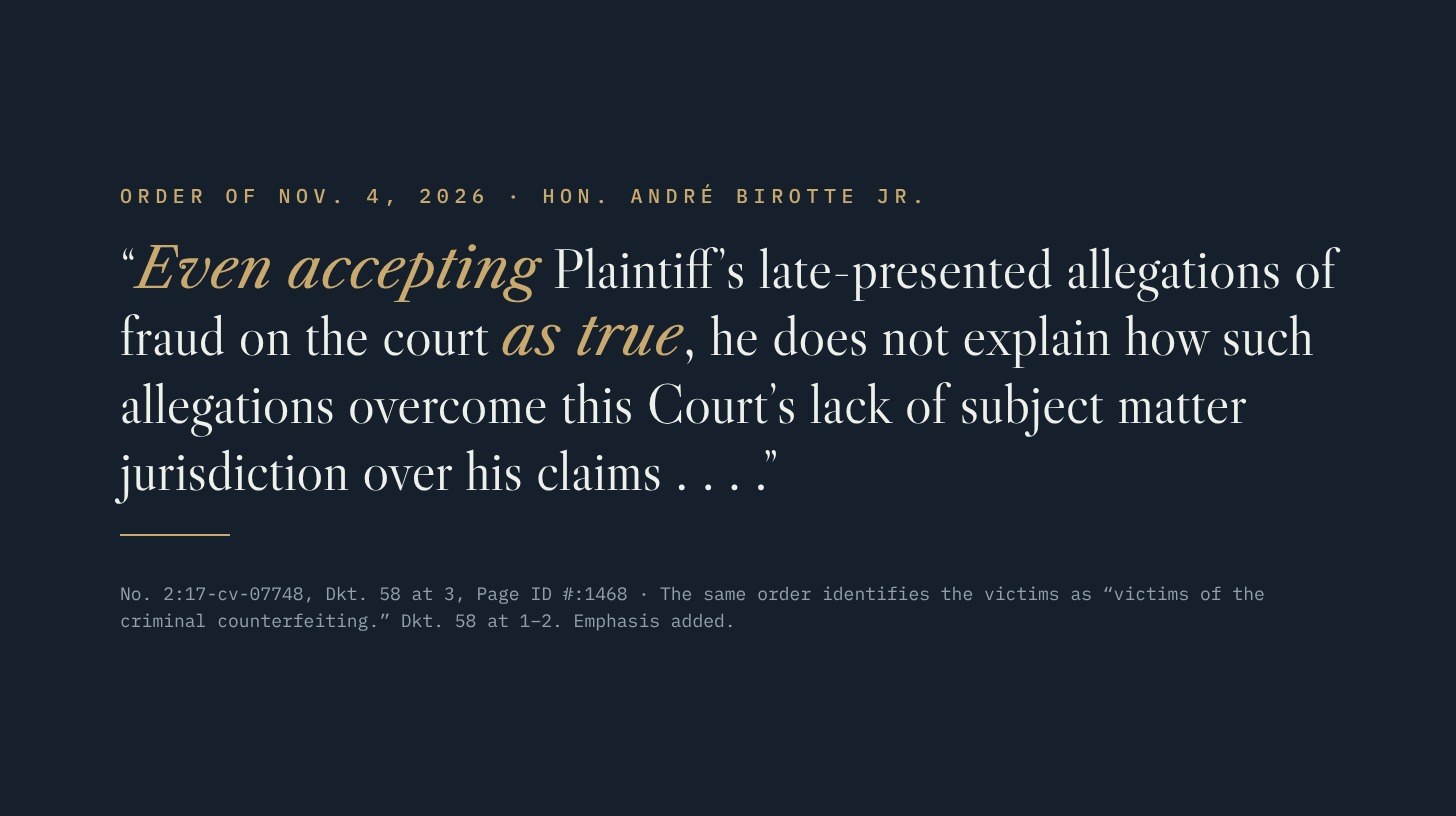
The case then went to the Honorable André Birotte Jr. On November 4, 2026, “[u]pon review of these filings and the entire docket,” Judge Birotte identified the victim and Greenway as “victims of the criminal counterfeiting.” (No. 2:17-cv-07748, Dkt. 58 at 1–2, Page ID #:1466–1467.) It was the first time that court had called them victims in its own words.
In the same order, he wrote:
“Even accepting Plaintiff’s late-presented allegations of fraud on the court as true, he does not explain how such allegations overcome this Court’s lack of subject matter jurisdiction over his claims . . . .” — No. 2:17-cv-07748, Dkt. 58 at 3, Page ID #:1468
On November 13, 2026, the victim mailed a second complaint of judicial misconduct to the Ninth Circuit, this one concerning Judge Birotte. It describes what the judge did after accepting the fraud allegations as true:
- He required nothing of the attorneys. He found “neither oppositions nor a hearing are necessary” and vacated the hearing. He required no response, no correction, and made no referral. (Dkt. 58 at 1, Page ID #:1466.)
- He struck the victim’s notices, including the victim’s notice of the pending complaint concerning Judge Wright, and warned that further filings “may be stricken.” (Dkt. 58 at 3 n.2, 4, Page ID #:1468–1469.)
- Restitution petitions remain undecided. The victims’ two petitions for restitution under Davis, which the Act requires be decided forthwith, have been pending since August 26 and September 14, 2026. (No. 2:26-cv-05207, Dkt. 49; No. 2:26-cv-09383, Dkt. 21.)
The complaint cites Canons 1, 2A, 3A(4) and 3B(6), and Rule 4(a)(4) of the Rules for Judicial-Conduct and Judicial-Disability Proceedings. That rule makes it misconduct to retaliate against anyone for “reporting or disclosing judicial misconduct.” The complaint asks the Chief Judge for a limited inquiry and for joint consideration with No. 26-90261. On November 10, Judge Birotte recused himself from a separate petition that named him. (No. 2:26-cv-13079, Dkt. 11.)
To be clear: neither complaint has been decided, and no finding of misconduct has been made. The Ninth Circuit will decide. What the public can see is the record, and the record is cited above.
How to assert your rights when a court falls short
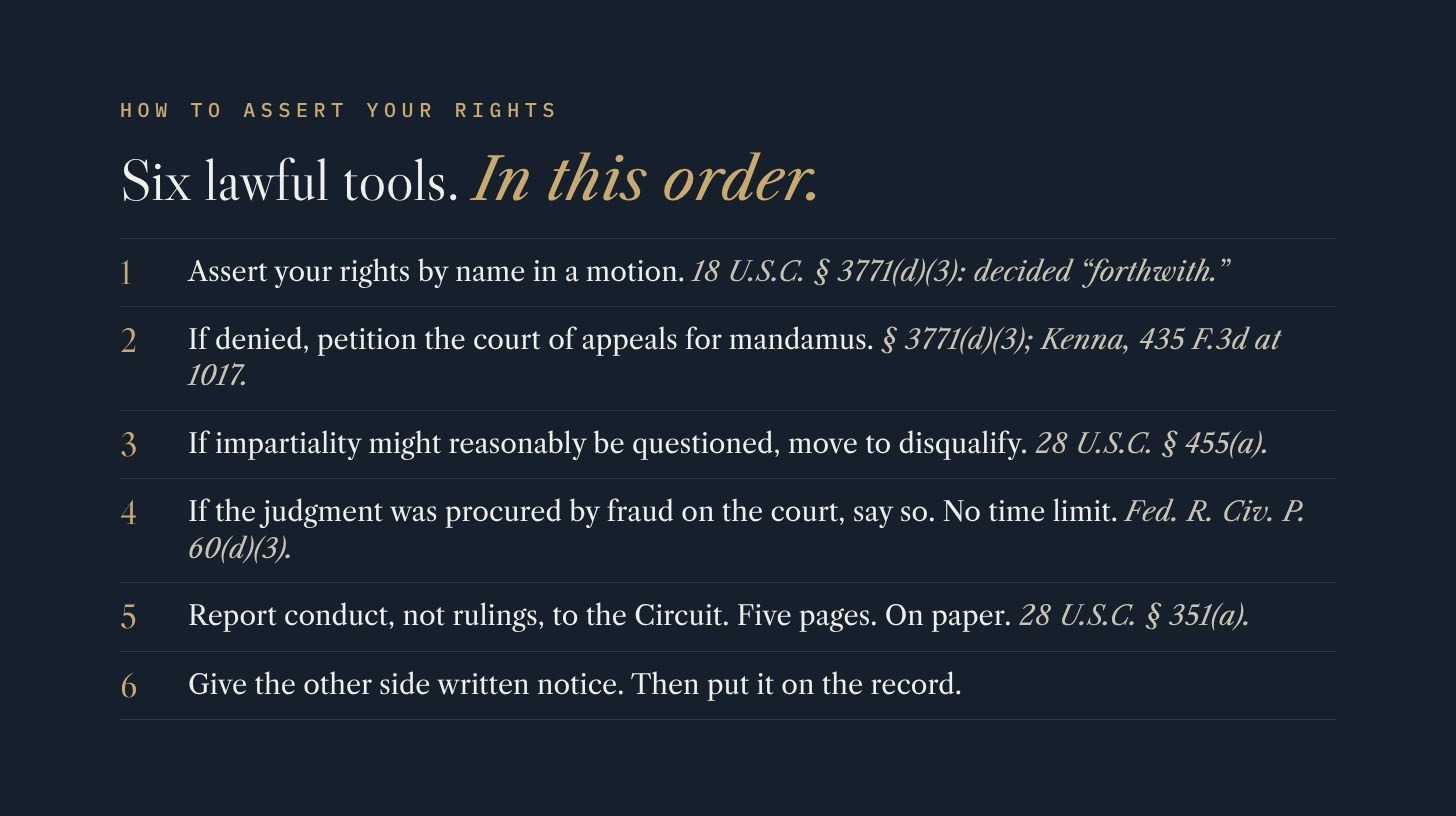
If you are a crime victim and a federal court is not honoring your rights, these are the lawful tools Congress and the courts have provided. The order matters.
- Assert your rights in writing, by name, in the case. File a motion under 18 U.S.C. § 3771(d)(3). Name each right you are asserting (for example, § 3771(a)(4), (a)(6), (a)(8)) and the specific relief you want. The statute requires the district court to decide it “forthwith.”
- If the district court denies relief, petition for a writ of mandamus. The Act lets a victim petition the court of appeals, which must decide the petition within 72 hours. 18 U.S.C. § 3771(d)(3). In the Ninth Circuit, the writ issues “whenever we find that the district court’s order reflects an abuse of discretion or legal error.” Kenna, 435 F.3d at 1017.
- If the judge cannot be impartial, move to disqualify. A federal judge “shall disqualify himself in any proceeding in which his impartiality might reasonably be questioned.” 28 U.S.C. § 455(a).
- If the judgment against you was procured by fraud on the court, say so. The court’s power to set aside such a judgment has no time limit. Fed. R. Civ. P. 60(d)(3); Hazel-Atlas, 322 U.S. at 246.
- Report conduct, not rulings, to the Circuit. A misconduct complaint cannot be used to argue that a ruling, including a refusal to recuse, was wrong. Rule 4(b)(1). It is for conduct: how the judge treated you, what the judge did with reliable information of misconduct, and whether you were penalized for reporting it. In the Ninth Circuit:
- Use the official complaint form, or list each judge’s name on the first page.
- Keep the Statement of Facts to no more than five pages.
- Mail it on paper to: Office of the Circuit Executive, Attn: Judicial Misconduct, P.O. Box 193939, San Francisco, CA 94119-3939. Email filings are not accepted.
- Cite the record by docket number and page. The Circuit asks for objective, verifiable proof, not opinion.
- Give notice, and put it on the record. Tell the opposing party in writing what you are filing and why. Then file a short notice in your case saying what you did, with the document attached.
How to conduct yourself
This is the part that matters most, and the part victims most often get wrong.
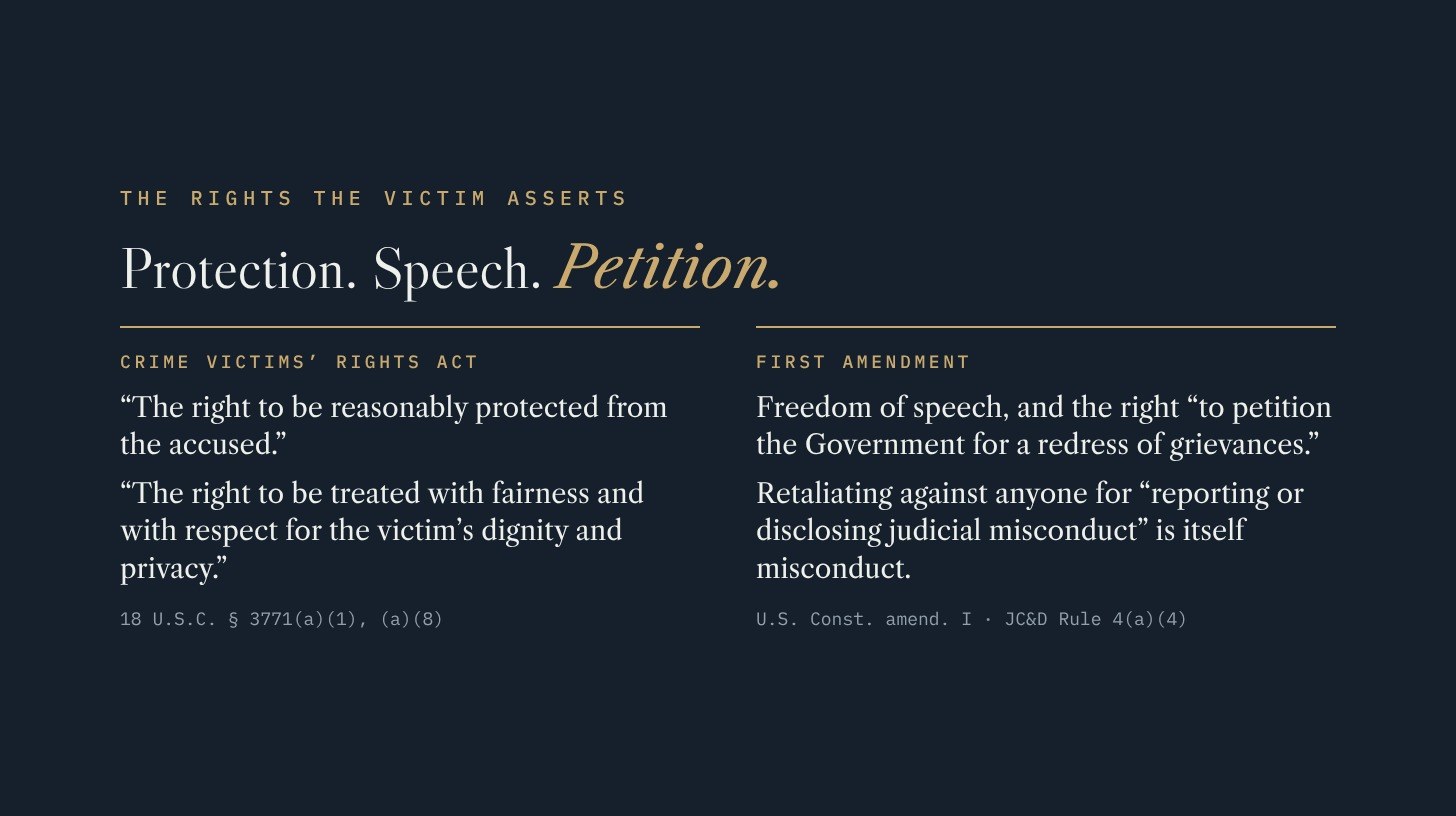
The victim in this story has asserted his rights as a crime victim, including the right to be reasonably protected from the accused, § 3771(a)(1), and the right to be treated with fairness and respect for his dignity, § 3771(a)(8). He has also asserted his rights under the First Amendment: to speak, and “to petition the Government for a redress of grievances.” U.S. Const. amend. I. A complaint of judicial misconduct is that kind of petition, and retaliating against someone for filing one is itself misconduct. Rule 4(a)(4). He has asserted all of these rights openly, on the record, in every case.
That is how every victim should conduct themselves:
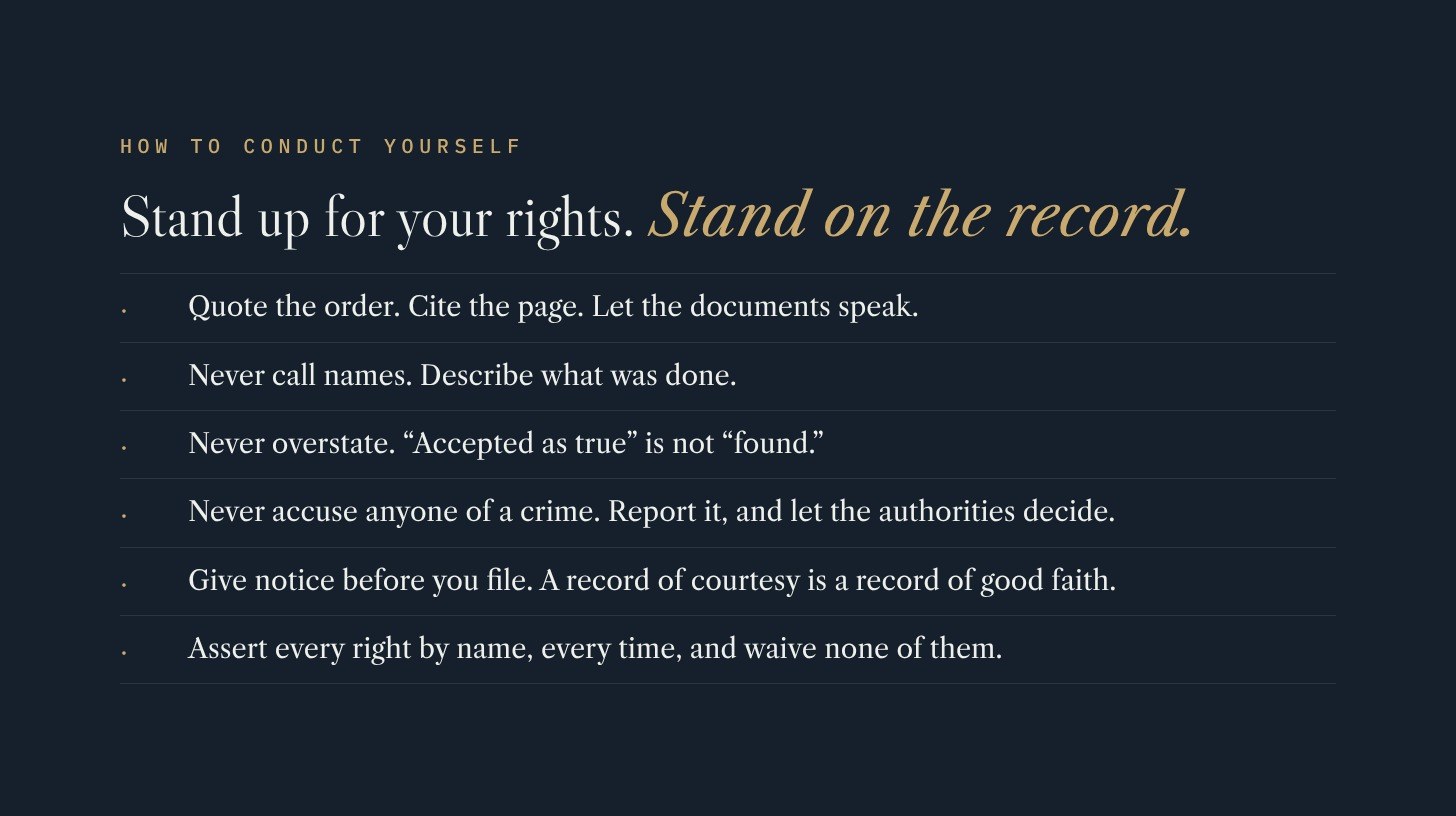
- Stick to the record. Quote the order. Cite the page. Let the documents speak.
- Never call names. Describe what a person did, not what you think of them. “The order struck the notice” carries more weight than any insult.
- Never overstate. Write “accepted as true,” not “found,” unless a court actually found it. Write “the complaint describes,” not “the judge is guilty.” Leave the conclusions to the people whose job it is to reach them.
- Never accuse anyone of a crime. Report what the record shows to the authorities responsible, and let them decide.
- Give notice before you file. Tell the other side in writing and invite their position. A record of courtesy is a record of good faith.
- Assert your rights by name, every time. A right you don’t assert is a right someone else will say you waived.
- Reserve everything. End every filing and letter by stating that you waive none of your rights.
You do not need a law degree to do this. You need patience, a calendar, a copy of the statute, and the will to keep going.
Why this matters
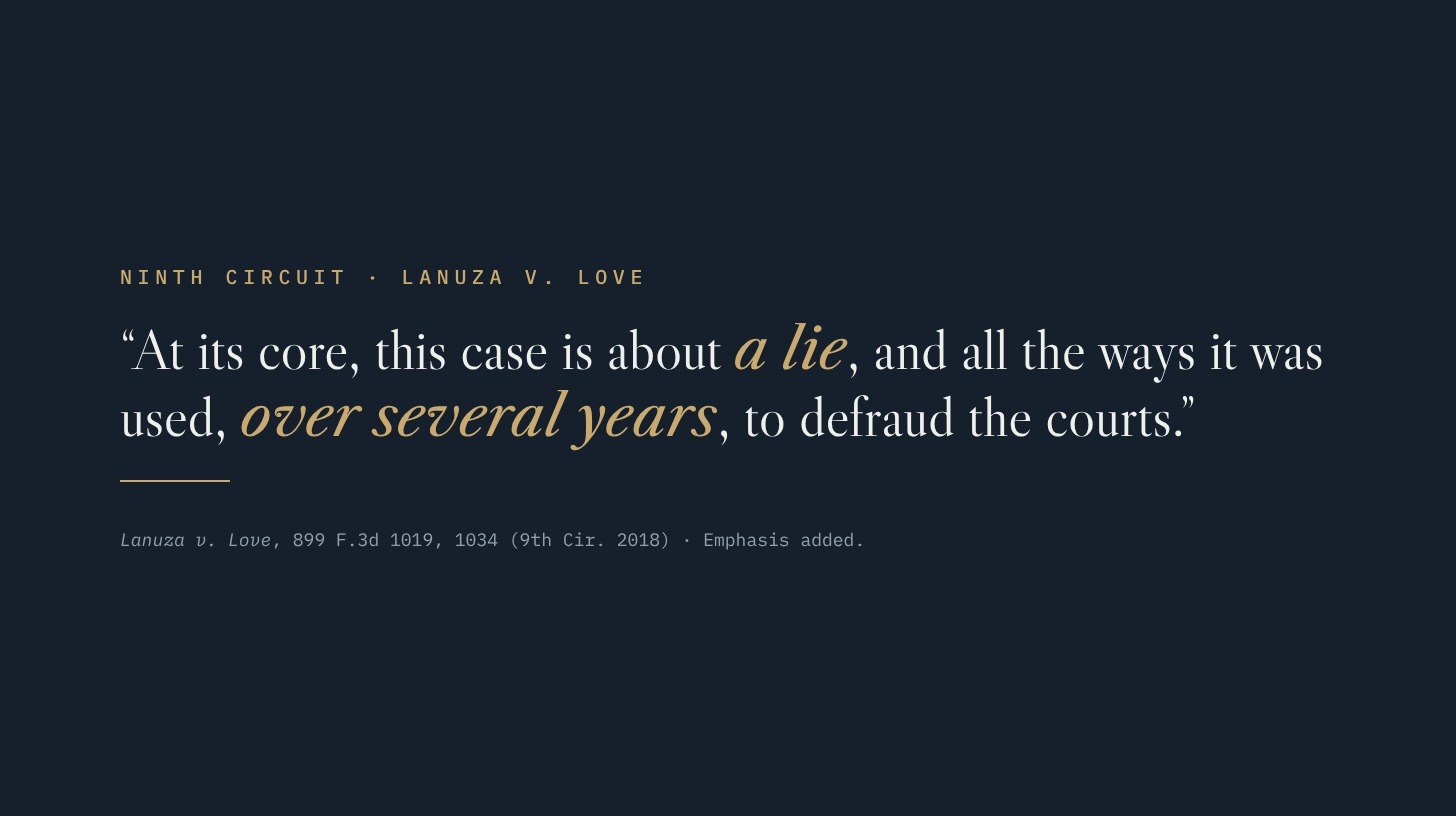
When a judge lets a lie stand, the harm does not stop with one victim. In the Ninth Circuit’s own words, “[a]t its core, this case is about a lie, and all the ways it was used, over several years, to defraud the courts.” Lanuza v. Love, 899 F.3d 1019, 1034 (9th Cir. 2018).
Victims’ rights are only as real as the courts are willing to make them. When a court will not, the law still gives victims a voice. Use it. Use it calmly, in writing, on the record, and with respect. And do not ever think about giving up or quitting. That is not now, nor can it ever be a useless thought for consideration.
“Let us not become weary in doing good, for at the proper time we will reap a harvest if we do not give up.” — Galatians 6:9

Gustavo Escamilla is a federally identified crime victim and a crime victims’ rights advocate. He is not an attorney, and nothing here is legal advice. The complaints described are pending before the Judicial Council of the Ninth Circuit; no finding of misconduct has been made. Every quotation is drawn from the cited court record or from the cited statute, rule, or opinion. The author asserts and reserves all of his rights as a crime victim under 18 U.S.C. § 3771, all of his rights under the First Amendment, and all other rights under applicable law, and waives none of them.