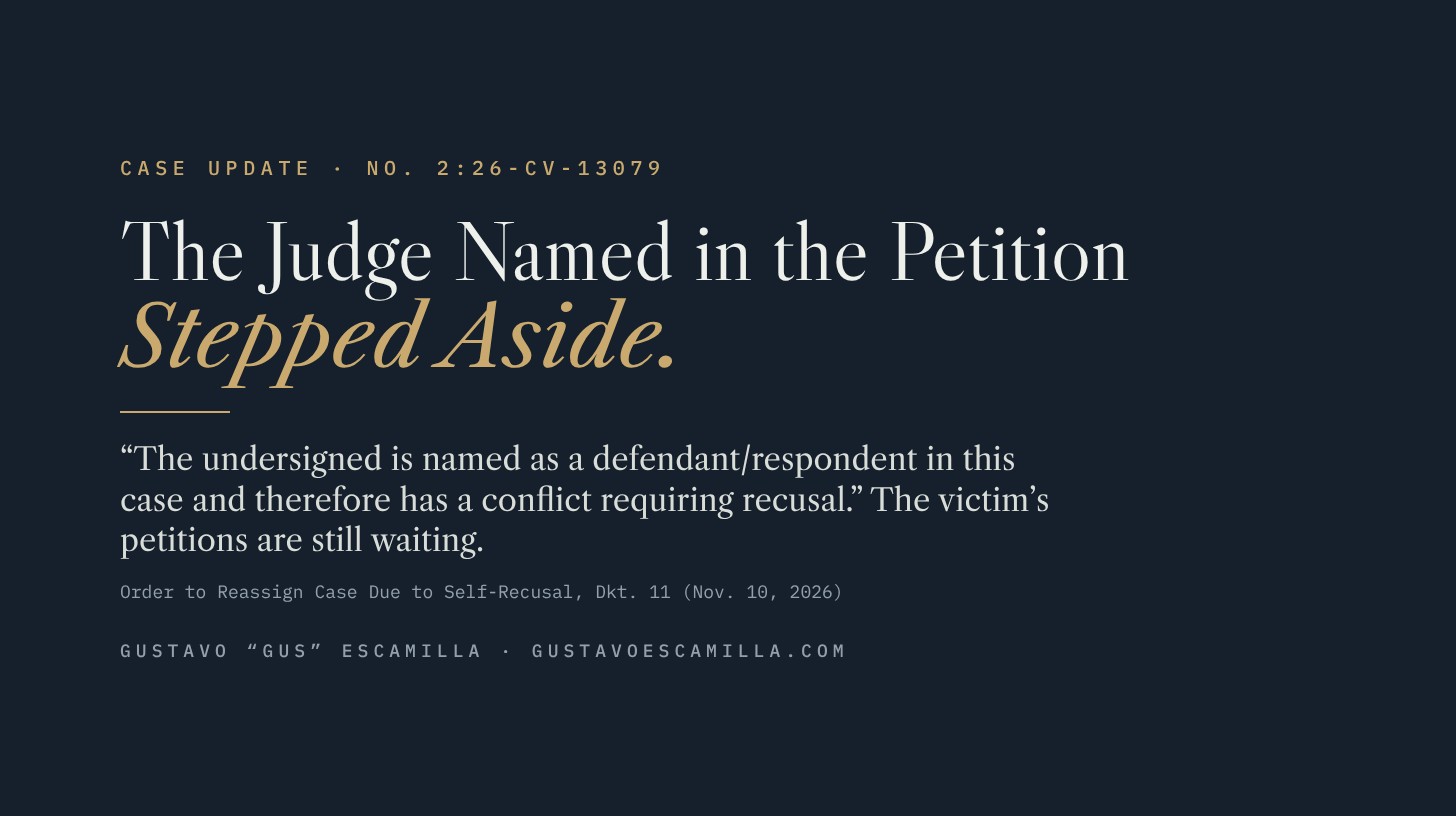
“The undersigned is named as a defendant/respondent in this case and therefore has a conflict requiring recusal.” — Order to Reassign Case Due to Self-Recusal, No. 2:26-cv-13079, Dkt. 11 (Nov. 10, 2026)
THE SHORT VERSION
- On November 6, 2026, a crime victim filed a new petition under the Crime Victims’ Rights Act and the Mandatory Victims Restitution Act. It asks the court to enforce the law’s command that a victim’s motion be decided “forthwith.”
- It names the judge presiding over his other petitions, in his official capacity.
- Four days later, that judge recused himself. The case was reassigned.
- The victim’s first petition was filed on May 14, 2026. It has not been decided. The government has never appeared.
The petition
Gustavo Escamilla runs Greenway Nutrients, Inc. In 2015, the Department of Homeland Security identified Greenway as a victim in a federal investigation. Since May 2026, he has asked the U.S. District Court in Los Angeles to enforce his rights as a crime victim, including the right to restitution. (No. 2:26-cv-05207, Dkt. 1; No. 2:26-cv-09383, Dkt. 1.)
The Crime Victims’ Rights Act puts courts on a clock. It says the district court “shall take up and decide any motion asserting a victim’s right forthwith.” 18 U.S.C. § 3771(d)(3).
On November 6, 2026, he filed a third petition, Escamilla v. United States, et al., No. 2:26-cv-13079. It seeks relief for the failure to take up and decide his pending petitions and motions forthwith. It names as respondents the United States, the Department of Justice, and the Honorable André Birotte Jr., in his official capacity, the judge to whom his earlier petitions are assigned. (No. 2:26-cv-13079, Dkt. 1.) It seeks no money damages from any judge.
Four days later
On November 9, the new case was assigned to Judge Birotte. On November 10, he signed an order recusing himself:
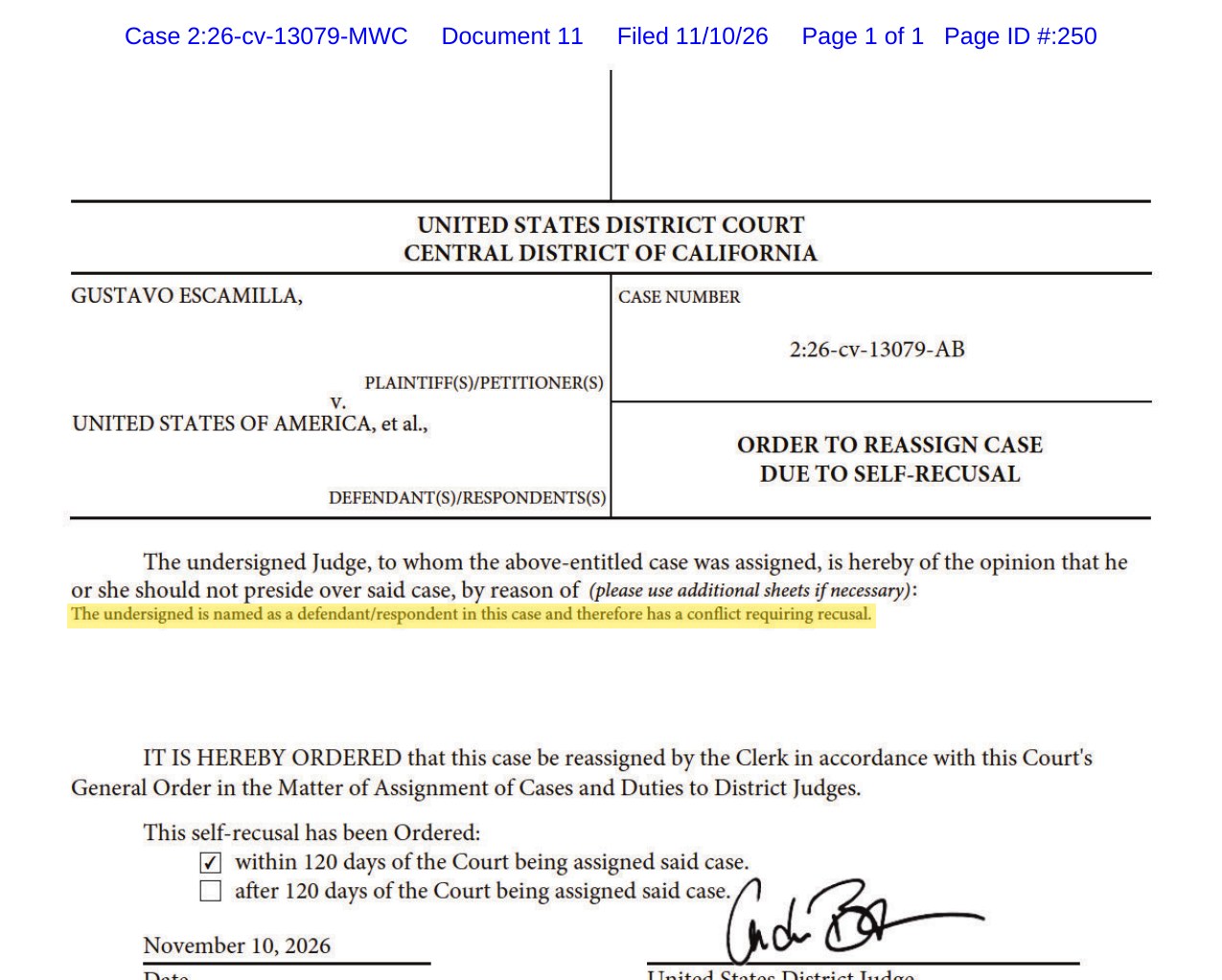
The case was reassigned to the Honorable Michelle Williams Court. (Dkt. 11.)
The principle is an old one. “[N]o man can be a judge in his own case.” In re Murchison, 349 U.S. 133, 136 (1955). Earlier this year, a different judge, the Honorable Otis D. Wright II, stepped aside from two of the victim’s cases after applications raising the same principle. (No. 2:26-cv-05207, Dkts. 47, 49; No. 2:17-cv-07748, Dkts. 26, 30.) Read more about that principle →
What happened next
November 12, 2026. The victim filed a notice that the court’s related-case procedure was never carried out, and asked that the Clerk complete it and that the Chief Judge be notified. (Dkt. 14.)
November 13, 2026. A judicial misconduct complaint concerning Judge Birotte was filed with the U.S. Court of Appeals for the Ninth Circuit and placed on the record. (Dkt. 19.) Under the Judicial Conduct and Disability Act, 28 U.S.C. §§ 351–364, the Ninth Circuit decides such complaints. It is pending. A separate complaint concerning Judge Wright, No. 26-90261, is also pending; it is on the record in No. 2:26-cv-09383 (Dkt. 58).
Still waiting
Judge Birotte stepped aside from the new case. The victim’s earlier petitions remain before him. On November 6, the victim filed notices of mandatory disqualification in both. (No. 2:26-cv-05207, Dkt. 54; No. 2:26-cv-09383, Dkt. 62.)
The first petition was filed on May 14, 2026. The U.S. Attorney’s Office was served on May 18, 2026. As of this writing, the government has not appeared in any of the three petitions, and none has been decided.
The statute says “forthwith.” The victim is still waiting.
If your motion is sitting
A crime victim does not have to wait quietly. If a district court does not act, the Crime Victims’ Rights Act lets a victim petition the court of appeals for a writ of mandamus, and the court of appeals must decide it within 72 hours. 18 U.S.C. § 3771(d)(3). Guide No. 2 walks through how it works →
Read it for yourself
Every filing cited here is a public court record. Read the petition, the recusal order, and the notices in the document library →
“Let justice roll down like waters, and righteousness like an ever-flowing stream.” — Amos 5:24
Frequently asked questions
What is No. 2:26-cv-13079?
A petition under the Crime Victims’ Rights Act and the Mandatory Victims Restitution Act, filed November 6, 2026, in the U.S. District Court for the Central District of California, seeking relief for the failure to decide a crime victim’s pending petitions “forthwith,” as 18 U.S.C. § 3771(d)(3) requires.
Why did the judge recuse himself?
The order states: “The undersigned is named as a defendant/respondent in this case and therefore has a conflict requiring recusal.” (Dkt. 11, Nov. 10, 2026.)
Who decides a judicial misconduct complaint?
Under the Judicial Conduct and Disability Act, 28 U.S.C. §§ 351–364, complaints about federal district judges in the Ninth Circuit are reviewed by the Ninth Circuit.
Gustavo Escamilla is a crime victim sharing what he has learned, not an attorney, and nothing here is legal advice. Statutes are quoted from the United States Code. If you are a crime victim, consult a lawyer or a victims’ rights organization about your own situation. Facts about the author’s own matters are drawn from the public court record. Nothing in this article waives any right, claim, or remedy of the author or of Greenway Nutrients, Inc., including under the Crime Victims’ Rights Act, the Mandatory Victims Restitution Act, and the Federal Tort Claims Act.
About the author. Gustavo “Gus” Escamilla is a crime victims’ rights advocate and speaker, and a federally identified crime victim. He writes about the rights federal and state law give crime victims, and what it takes to enforce them. GustavoEscamilla.com · Substack · YouTube · X